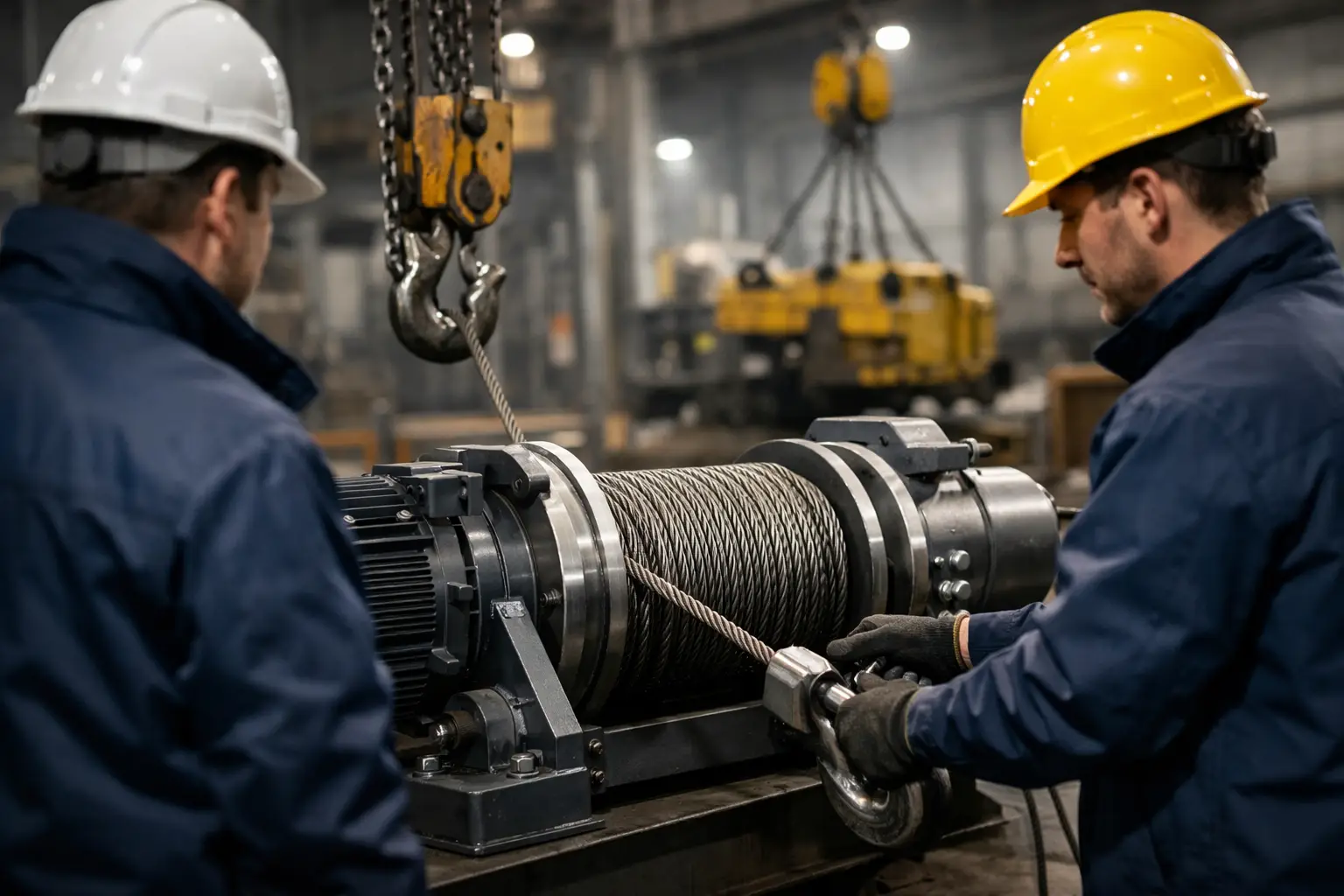
A winch that can pull a stated load once is not necessarily suitable for lifting it repeatedly, positioning it precisely, or operating safely through a full production shift. When plant uptime, personnel safety, and material flow are at stake, selecting the best winches for heavy loads means matching the equipment to the actual duty, load path, controls, and service conditions at the facility.
For industrial applications, a winch should be treated as part of a complete lifting or pulling system, not as an isolated piece of equipment. The drum, wire rope, gearbox, brake, motor, limit devices, mounting structure, sheaves, controls, and inspection access must work together. A correctly engineered system reduces unplanned downtime and gives operations teams confidence that demanding work can be completed consistently.
What Makes a Winch Suitable for Heavy Loads?
Heavy-load winches are selected on more than their rated line pull. The first question is whether the application involves lifting, pulling, positioning, or recovery. These tasks impose different requirements on braking, control accuracy, rope management, and safety devices.
A lifting winch raises or lowers a suspended load and requires a dependable holding brake, appropriate upper and lower limits, and controls that prevent uncontrolled movement. A pulling winch moves a load horizontally or along an incline. It may need substantial tractive effort, but it is not automatically designed or approved for suspended lifting. Using a pulling winch to lift personnel, machinery, or materials without the necessary lifting design and protection creates a serious safety risk.
The stated capacity also needs careful interpretation. A winch typically delivers its highest line pull on the first layer of rope around the drum. As more rope builds up, the effective drum diameter increases and available line pull decreases. If the application regularly uses a fully loaded drum, the selected winch must have sufficient capacity at the relevant rope layer, not only at the first layer.
Duty cycle is equally important. A unit intended for occasional short pulls can overheat quickly when used for frequent lifting cycles. Motor rating, gearbox thermal capacity, brake design, and control system all affect how long a winch can operate before performance or equipment life is compromised.
Best Winches for Heavy Loads: Start With the Application
There is no universal best option. The right choice depends on the material being handled, the travel distance, lifting height, operating frequency, available power, environmental conditions, and required level of control.
Electric wire-rope winches for fixed industrial duties
Electric wire-rope winches are often the practical choice for factories, workshops, warehouses, and process facilities where a reliable power supply is available. They can provide high capacity, consistent operation, and integration with pendant controls, radio controls, variable-speed drives, or automated systems.
For frequent use, electric winches should be specified with a motor and duty rating that reflect actual cycle times. A short lift with a long rest period places a different demand on the equipment than continuous repositioning of steel coils, molds, or fabricated assemblies. Variable-speed control may add initial cost, but it can improve positioning, reduce load swing, and limit shock loading on the machinery and supporting structure.
Hydraulic winches for demanding mobile or remote work
Hydraulic winches are well suited to mobile equipment, construction-related work, marine environments, and locations where hydraulic power is already available. They can offer smooth control and strong pulling performance, particularly where electric supply is limited or unsuitable.
Their performance depends on the complete hydraulic circuit. Flow rate, pressure, hose sizing, cooling, filtration, and valve settings must be designed as a system. A hydraulic winch with inadequate cooling or contaminated fluid will not deliver dependable heavy-duty service, regardless of its rated capacity.
Planetary and worm-gear configurations
Gear arrangement affects winch behavior. Planetary gear winches are compact and efficient, making them common where high line pull is required within limited installation space. Worm-gear winches can offer favorable load-holding characteristics in certain designs, though efficiency and speed may be lower.
The selection should not be based on gearbox type alone. Brake configuration, duty cycle, maintenance access, required line speed, and manufacturer support matter more than a single design label. An engineering review should confirm that the gearbox and brake are suited to the actual load spectrum rather than only the maximum theoretical load.
Capacity Calculations Need a Safety Margin
The load on a winch is rarely limited to the item being moved. The calculation should include the weight of lifting attachments, hooks, spreader beams, grabs, pallets, rope, and any components that travel with the load. Friction, incline, acceleration, reeving arrangement, and dynamic effects can significantly change the required line pull.
For example, a winch moving a 10-ton load on a rail-guided trolley may require more than the simple rolling resistance calculation if the system must accelerate quickly, operate on an incline, or overcome misalignment. A suspended load can also impose dynamic loading when started or stopped abruptly. These forces affect the winch, rope, anchor point, supporting steelwork, and foundations.
A sensible capacity margin is necessary, but oversizing without considering speed and control can create a different problem. An excessively fast or powerful winch may make fine positioning difficult and increase the consequences of operator error. The objective is fit-for-purpose performance: adequate capacity, controlled motion, and a system that can be inspected and maintained safely.
Do Not Overlook Rope, Drum, and Reeving Design
Wire rope is a critical working component, not an accessory. Its diameter, construction, breaking strength, flexibility, lubrication requirements, and resistance to abrasion must suit the drum and sheave arrangement. Incorrect rope selection can accelerate wear, cause crushing on the drum, and reduce the service life of the entire system.
Drum dimensions and rope capacity should accommodate the full working travel while retaining the required minimum wraps of rope on the drum. Fleet angle must also be controlled. A poor fleet angle causes uneven spooling, rope damage, and side loading that may lead to premature failure.
Reeving can increase lifting capacity by using multiple parts of line, but it reduces line speed and introduces additional sheaves, bearings, and inspection points. It is often a sound approach for heavy lifting when speed is not the main priority. The trade-off should be assessed early, particularly where headroom, hook travel, or space around the load is limited.
Brakes, Limits, and Controls Protect the Operation
For lifting applications, braking performance is non-negotiable. The primary brake must hold the rated load under the intended operating conditions. Depending on the risk assessment and system design, secondary braking or additional mechanical protection may also be required.
Upper and lower travel limits prevent over-hoisting and over-lowering. Over-hoisting can pull a hook block into the drum or sheaves, while excessive lowering can leave too few rope wraps on the drum. These are avoidable incidents when limit devices are correctly selected, installed, tested, and maintained.
Control choice should reflect the task and visibility. A pendant control is often effective where the operator works close to the load. Radio control may improve visibility and keep the operator outside the immediate load path. For repetitive processes, interlocks, load monitoring, variable-speed drives, and automated positioning can improve consistency. However, added control features should remain accessible for troubleshooting and should not make routine maintenance unnecessarily complex.
Installation Is Part of Winch Performance
Even the best-designed winch will underperform if mounted on an unsuitable foundation or structure. The supporting steelwork, anchor bolts, base plate, rope lead, and load path must be verified by competent personnel. Misalignment can cause rope spooling problems, abnormal gearbox loading, and excessive wear.
Installation planning should also consider electrical isolation, hydraulic access where relevant, drainage, weather protection, safe access for inspection, and space for rope replacement. In busy facilities, the location of controls and the movement of people, forklifts, and other equipment should be reviewed before commissioning.
At MFEI, heavy-load winch selection is approached as a lifting-system engineering task. This helps ensure that equipment capacity, site constraints, installation requirements, spare-parts availability, and long-term service needs are considered before the winch enters operation.
Serviceability Determines Long-Term Value
The purchase price is only one part of the cost of ownership. A heavy-load winch should be selected with a realistic maintenance plan that covers routine inspection, lubrication, brake checks, rope examination, limit-switch testing, and replacement of wear components.
Maintenance teams need practical access to the motor, brake, gearbox, drum, rope anchor, and electrical panel. If basic inspection requires extensive dismantling or production shutdowns, necessary work may be delayed. That delay can turn a manageable wear issue into a costly failure.
Local parts support also deserves attention. Items such as brake linings, contactors, limit switches, bearings, rope, and control components should be obtainable within a timeframe that aligns with the facility’s uptime requirements. For operations in Malaysia, local technical support and spare-parts planning can materially reduce the duration of an unexpected outage.
Before purchase, ask suppliers for the expected inspection intervals, recommended spare parts, service documentation, and the process for emergency technical support. These practical questions often reveal whether a proposed winch is truly intended for industrial duty.
A heavy-load winch earns its value through predictable, controlled work over many years. Choose one that fits the load and duty, then give equal attention to the structure, controls, rope system, installation quality, and maintenance support behind it.