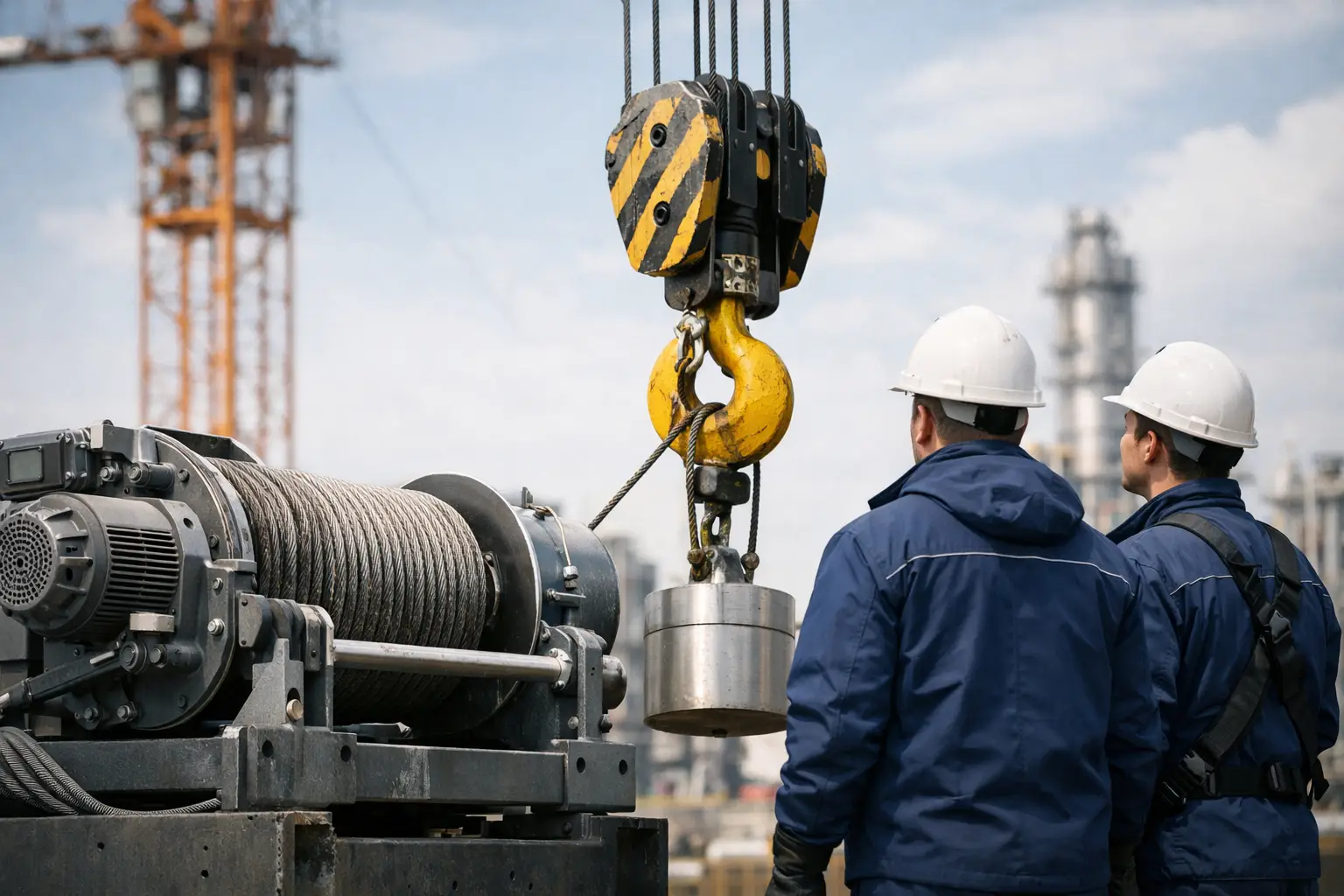
A winch that moves a load successfully once is not necessarily suitable for daily industrial work. Industrial winches must perform predictably through repeated cycles, changing load conditions, operator demands, and the realities of the installation environment. For plant and warehouse teams, the right choice is less about selecting the highest-rated unit and more about engineering a lifting or pulling system that remains safe, serviceable, and economically sound over its working life.
Start With the Actual Work, Not the Catalog Rating
The rated line pull is a necessary starting point, but it is not the full specification. A winch used to pull machinery across a workshop floor faces different forces from one lifting a suspended load, positioning a heavy gate, tensioning material, or recovering a trolley. The line pull also changes as wire rope builds in layers on the drum. The first layer typically provides the highest pulling force, while outer layers increase line speed and reduce available pull.
The required capacity should account for the maximum working load, the route of travel, friction, incline, reeving arrangement, and a suitable safety margin. For lifting applications, the complete system must be designed around the load path, including the supporting structure, rope termination, hook or attachment point, sheaves, limit devices, and controls. A capable winch cannot compensate for an underspecified beam, poor anchorage, or incorrect reeving.
Duty cycle deserves equal attention. A unit that is appropriate for occasional maintenance lifts may overheat or suffer premature brake, gearbox, or motor wear when used continuously on a production line. Before specifying equipment, establish how many starts, stops, lifts, and operating minutes are expected per hour and per shift. This gives the engineering team a practical basis for matching motor capacity, thermal performance, gearing, and control configuration to the application.
Selecting Industrial Winches by Application
Industrial winches are often grouped by capacity, but application is the more useful way to begin. Electric winches are commonly selected where consistent, repeatable operation and available power supply make them practical. They can support precise control and frequent use, provided their motor rating and electrical protection suit the duty.
Hydraulic winches can be well suited to mobile machinery and demanding outdoor applications where hydraulic power is already available. Their suitability depends on the hydraulic system’s pressure, flow, cooling capacity, and maintenance condition. Pneumatic winches may be considered in certain environments where compressed air is preferred and electrical equipment requires additional consideration. However, air quality, pressure stability, noise, and energy consumption still need to be evaluated.
The correct choice depends on site conditions and operating behavior. A coastal facility may require stronger corrosion protection. A dusty production area may need enclosures and maintenance practices that prevent contamination. A confined installation may prioritize compact dimensions and access for inspection. For an outdoor construction-related application, weather exposure and power availability may drive the decision more than line speed alone.
Lifting and Pulling Are Not Interchangeable
This distinction is fundamental. A winch intended for horizontal pulling should not automatically be used to lift suspended loads. Lifting duty requires controls and safety features appropriate to the consequences of a falling load, including properly designed braking arrangements, overload protection where applicable, limit controls, and rated lifting accessories.
The operating team should also be clear about whether people could enter the load zone or work beneath the load. No design decision should rely on operator caution alone. Physical exclusion zones, clear procedures, suitable controls, and regular inspection are all part of a safe lifting system.
The Details That Determine Reliability
Many avoidable failures begin with small specification gaps. Wire rope selection, for example, affects drum life, fatigue performance, crushing resistance, flexibility, and inspection requirements. The rope diameter, construction, lay direction, minimum breaking force, and compatibility with the drum and sheaves must work together. Poor spooling can damage rope quickly, especially where fleet angle is excessive or the drum does not have adequate capacity for the required rope length.
Brakes must be selected for the actual risk and operating sequence. A holding brake that keeps a stationary load in position is not necessarily the same as a dynamic braking arrangement intended to control moving loads. Emergency-stop behavior, power-loss response, and brake inspection access should be discussed before installation, not after commissioning.
Control selection also affects safety and productivity. Pendant controls may be suitable where the operator needs to remain close to the work. Radio control can improve visibility and separation from the load zone, but it requires disciplined battery management, secure pairing, and clear operating procedures. Variable-speed control can help where accurate positioning matters, although it adds cost and complexity that may not be justified for simple, infrequent pulls.
A practical specification review should address at least these points:
- Maximum working load, including load orientation and any dynamic effects
- Required line speed, rope length, and drum capacity
- Expected duty cycle and number of starts per hour
- Power source, controls, and environmental protection requirements
- Supporting structure, anchorage, access, and maintenance clearances
These items are connected. A faster line speed can require a larger motor. A longer rope can require a larger drum. A compact installation can restrict access to the gearbox, brake, or rope anchorage. Looking at each item separately is how an apparently suitable system becomes difficult to operate or expensive to maintain.
Design for Service Access From Day One
Winches are mechanical systems, and planned maintenance is part of their operating cost. The most practical equipment is not always the lowest initial-price option. It is the system that can be inspected, lubricated, adjusted, and repaired without creating lengthy production interruptions or unsafe maintenance work.
Service access should include room to inspect the wire rope across its full working length, check drum condition, test controls and limit devices, assess brake operation, and reach electrical or hydraulic components. If the equipment is installed high above a process area, consider how technicians will access it safely. A design that needs scaffolding or extensive shutdown activity for routine work will raise lifecycle costs.
Local availability of common wear parts also matters. Rope, hooks, bearings, brake components, contactors, switches, and control accessories should be considered during the selection stage. Standardizing critical components across multiple units can simplify spare-parts planning and reduce downtime when a repair is required.
Installation and Commissioning Are Part of the Equipment
A correctly manufactured winch can still perform poorly if installation is treated as an afterthought. Alignment between the drum and lead sheave, correct anchoring, electrical protection, grounding, control routing, and load testing all influence the final result. The installation should be verified against approved drawings and the real site condition, particularly where structures, headroom, or access differ from early project assumptions.
Commissioning is the point to test normal operation and foreseeable fault conditions. Confirm direction of travel, limit settings, brake response, emergency stops, controls, rope spooling, and rated-load behavior. Operators should receive clear instruction on permitted use, pre-use checks, reporting procedures, and the limits of the system. A commissioning record provides a useful baseline for future inspections and maintenance decisions.
For customized lifting and material-handling projects, early involvement from an engineering partner can prevent late changes that affect cost and schedule. MFEI approaches this work by considering the complete lifecycle: application requirements, site constraints, installation, spare-parts support, and planned maintenance. That approach is especially valuable when a standard winch package does not fit the available space, operating duty, or budget.
Treat Inspection Findings as Operating Data
Routine inspections should not become a paperwork exercise. Changes in rope condition, unusual noise, heat buildup, erratic control response, brake drift, oil leaks, or poor spooling are early signals that deserve action. Waiting for complete failure can turn a manageable repair into an extended shutdown and a larger safety concern.
Inspection frequency should reflect how the winch is used, its environment, and the consequences of failure. A lightly used maintenance winch and a production-critical unit operating several shifts a day should not receive identical attention. Keep service records detailed enough to identify recurring faults, component life trends, and opportunities to improve operating practice.
The best time to question a winch specification is before the purchase order, when changes are still manageable. Bring the load data, operating pattern, site drawings, and maintenance expectations into the same discussion. A system designed around those facts gives your team something more valuable than lifting capacity: dependable control over the work that keeps your facility moving.