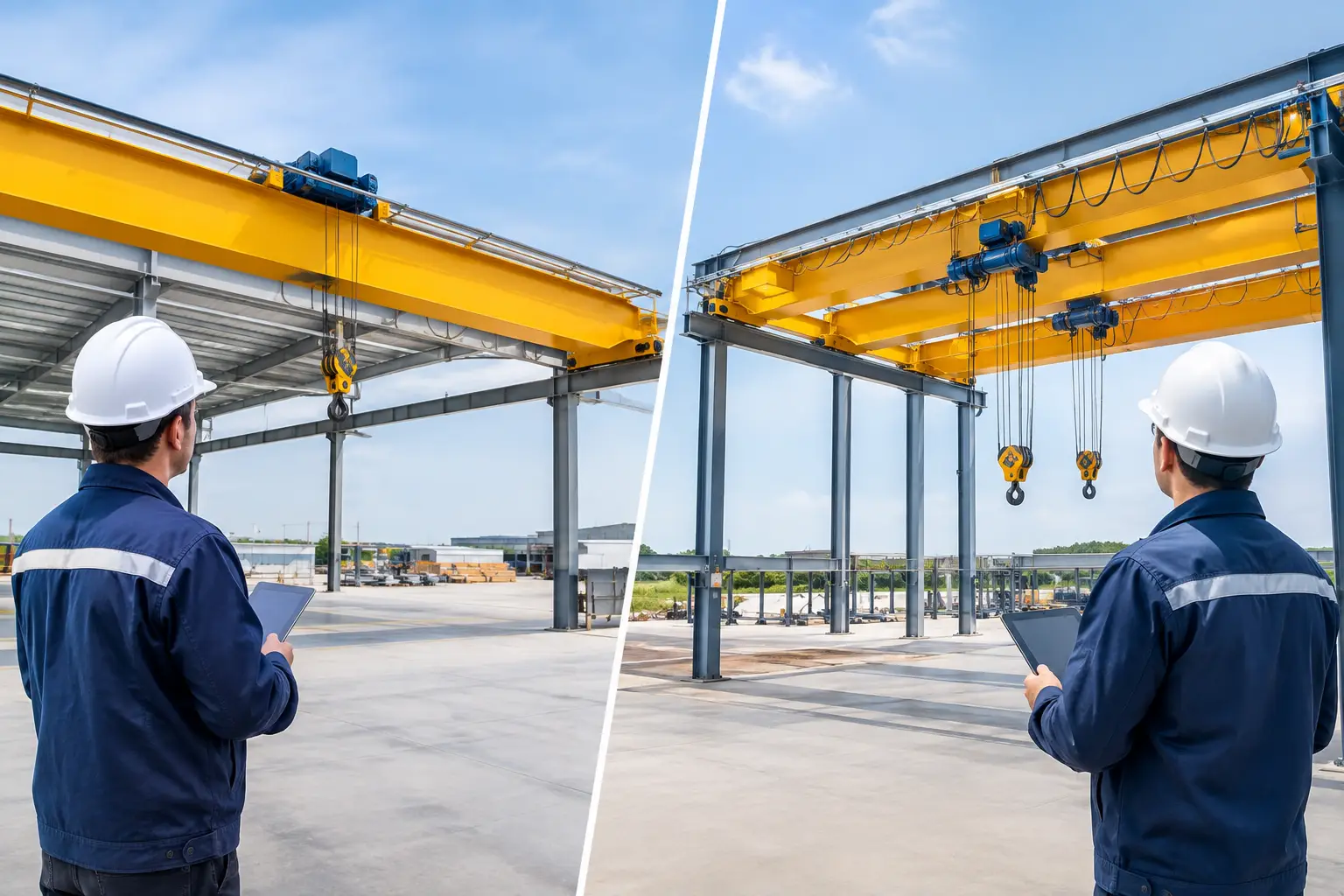
A crane specification can look suitable on paper yet create expensive constraints once it reaches the factory floor. A proper single girder double girder comparison goes beyond rated capacity. It should account for span, available headroom, lifting height, load handling frequency, building structure, maintenance access, and the cost of supporting the crane throughout its working life.
For many facilities, a single girder overhead crane is the practical and economical answer. For others, a double girder configuration provides the height, capacity, control, and duty capability that the operation cannot compromise. The correct choice is the one that supports safe, repeatable material handling without asking the building, hoist, or maintenance team to operate at its limits.
Single Girder vs. Double Girder: The Fundamental Difference
A single girder overhead crane uses one main bridge beam spanning between end carriages. The hoist typically runs on the lower flange of that beam, usually as an under-running trolley. This arrangement has fewer major structural members and can reduce the crane’s own weight, fabrication requirements, and installation cost.
A double girder overhead crane uses two bridge beams. The hoist trolley travels on rails installed above the girders, allowing the hoist to sit higher in the bridge structure. This fundamental layout changes the crane’s lifting geometry and makes double girder systems suitable for applications requiring greater hook height, larger capacities, longer spans, or more demanding operating cycles.
Neither design is automatically better. A light-to-medium-duty workshop lifting fabricated parts may gain little from a double girder crane. A production line repeatedly handling heavy dies, molds, coils, or machinery may need the additional capability and control it provides.
Capacity Is Only the Starting Point
Rated capacity is the first figure most buyers consider, but it should not be treated as the selection decision by itself. Both single and double girder cranes can serve a range of capacities. The question is how the crane will perform at that capacity across the required span, lift height, duty cycle, and travel pattern.
Single girder cranes are commonly selected for lighter to moderate loads and standard industrial service. Their lower dead weight may also place less demand on an existing runway structure, which can be a meaningful advantage during a plant upgrade or warehouse conversion.
Double girder cranes generally become more appropriate as load capacity and span increase. Two girders distribute bridge loading more effectively and provide a stable platform for a top-running trolley. This is particularly valuable where loads must be positioned precisely, where long loads may sway, or where the crane works frequently near its rated capacity.
An engineering review should also include the weight of below-the-hook equipment. A lifting beam, magnet, grab, vacuum lifter, coil tong, or custom fixture reduces the net payload available for the product being lifted. The selected crane capacity must cover the full lifted load, including the hoist hook block and attachment, with the required safety margin.
Duty Cycle Changes the Answer
A crane that makes a few lifts each day has a very different requirement from a crane supporting continuous production. Frequent starts, stops, long travel distances, high lifting speeds, and repeated operation near maximum load all increase wear on the hoist, trolley, bridge, wheels, and runway.
For intermittent handling, a single girder system may offer sound value and dependable performance. For higher-duty work, a double girder crane can provide a stronger basis for selecting larger hoists, more suitable wheel loads, better travel arrangements, and controls designed for repetitive service. The final decision should be based on the actual operating class, not simply an estimate of the heaviest item in the facility.
Headroom and Hook Height Often Decide the Project
Headroom is the vertical space between the runway level and the underside of the roof or other obstruction. Hook height is the maximum vertical position available to lift the load. These are related, but they are not the same measurement.
A single girder crane places the hoist below the bridge beam. In a building with limited vertical clearance, this can reduce the available hook height. If operators need to lift tall machines, stack materials high, or clear process equipment, the lost lifting height may affect workflow every day.
With a double girder arrangement, the trolley and hoist sit above the main girders. This can achieve a higher hook position in the same building, although the actual result depends on the hoist design, rail arrangement, building steelwork, and clearance requirements. Where every inch of lift matters, a double girder system often justifies its higher initial cost.
Site measurement must be precise. Roof trusses, lighting, ducts, fire protection piping, cable trays, doors, and existing equipment can all restrict the crane envelope. An experienced crane engineer will review these conditions before finalizing the design, rather than discovering conflicts during installation.
Structural Requirements and Installation Considerations
The crane bridge is only one part of the lifting system. The runway beams, runway rails, columns, brackets, foundations, and building frame must be assessed as a complete load path. A crane’s dead weight, lifted load, impact effects, acceleration, braking, and lateral forces all transfer into the supporting structure.
Because single girder cranes are often lighter, they can be an efficient option when an existing building has limited structural reserve. That does not remove the need for verification. A runway designed for a lighter crane cannot be assumed suitable for a new system simply because the rated lifting capacity appears similar.
Double girder cranes usually impose greater bridge and wheel loads, particularly at higher capacities. They may require a more substantial runway or additional structural work. However, this investment can be justified if the system avoids a building extension, provides needed hook height, or supports a higher level of production activity.
Installation planning should also cover access for lifting the girders into place, electrical supply, conductor systems, control location, safety clearances, and future maintenance access. A low purchase price loses its value if installation disruption, structural modifications, or access limitations were not identified early.
Cost Should Be Evaluated Across the Equipment Life
A single girder crane generally has a lower initial equipment cost. It uses less steel, has a simpler bridge arrangement, and may reduce freight and installation requirements. For a facility with suitable capacity, span, and duty conditions, this can be the commercially sensible solution.
A double girder crane normally requires a greater initial investment. The additional girder, top-running trolley arrangement, runway requirements, and higher-specification components can increase project cost. Yet its value may be stronger over time when it improves lifting height, reduces load-handling constraints, supports heavier process equipment, or better matches demanding use.
Maintenance costs should be included in the decision from the outset. Access to the hoist, gearbox, brakes, electrical panels, wheels, and current collection components affects service time and downtime. Availability of compatible spare parts matters as much as the original equipment specification, especially where the crane supports a critical production area.
A fit-for-purpose design considers total operating cost: planned inspections, preventive maintenance, replacement parts, expected duty, operator training, and the consequences of an unplanned stoppage. The least expensive crane to purchase is not always the least expensive crane to own.
Control, Stability, and Application Needs
Double girder cranes provide a wider bridge platform and can be well suited to specialized lifting arrangements. They are often selected for multiple hoists, maintenance platforms, walkways, cabin controls, magnets, rotating devices, or other engineered attachments. Their configuration can also offer advantages for precise load positioning in larger or more complex work zones.
Single girder cranes remain highly effective for many standard lifting tasks. With the correct hoist, variable-speed controls, radio remote system, limit switches, and safety devices, they can safely handle routine movement of components, raw materials, and finished goods. The key is not to specify features that the operation will never use, or to omit features that operators need every shift.
For either crane type, clear travel paths and operator visibility are essential. Loads should not be routinely pulled sideways, passed over personnel, or maneuvered through congested areas without a controlled handling plan. Crane design and workplace layout should work together.
Questions to Settle Before Selecting a Crane
Before approving a design, establish the maximum lifted load, including attachments; required span and runway length; minimum and maximum hook height; number of lifts per hour and per shift; required lifting and travel speeds; and whether the load needs precise positioning. Also confirm the available building structure and whether operations may expand in the near future.
It is useful to consider the next five to ten years, but avoid overspecifying based on uncertain plans. A crane engineered for realistic growth can protect the investment. A system oversized without operational need can add unnecessary capital and structural cost.
For facilities in Malaysia, local engineering support, installation coordination, available spare parts, and planned maintenance capability should carry real weight in the procurement decision. MFEI approaches crane selection as a site-specific lifting solution, aligning bridge design, hoisting equipment, runway conditions, and lifecycle service requirements with the way the facility actually operates.
The most useful decision is not single girder or double girder in isolation. It is a crane system that gives operators the lifting height, control, reliability, and service support they need – without paying for capability the operation will not use.