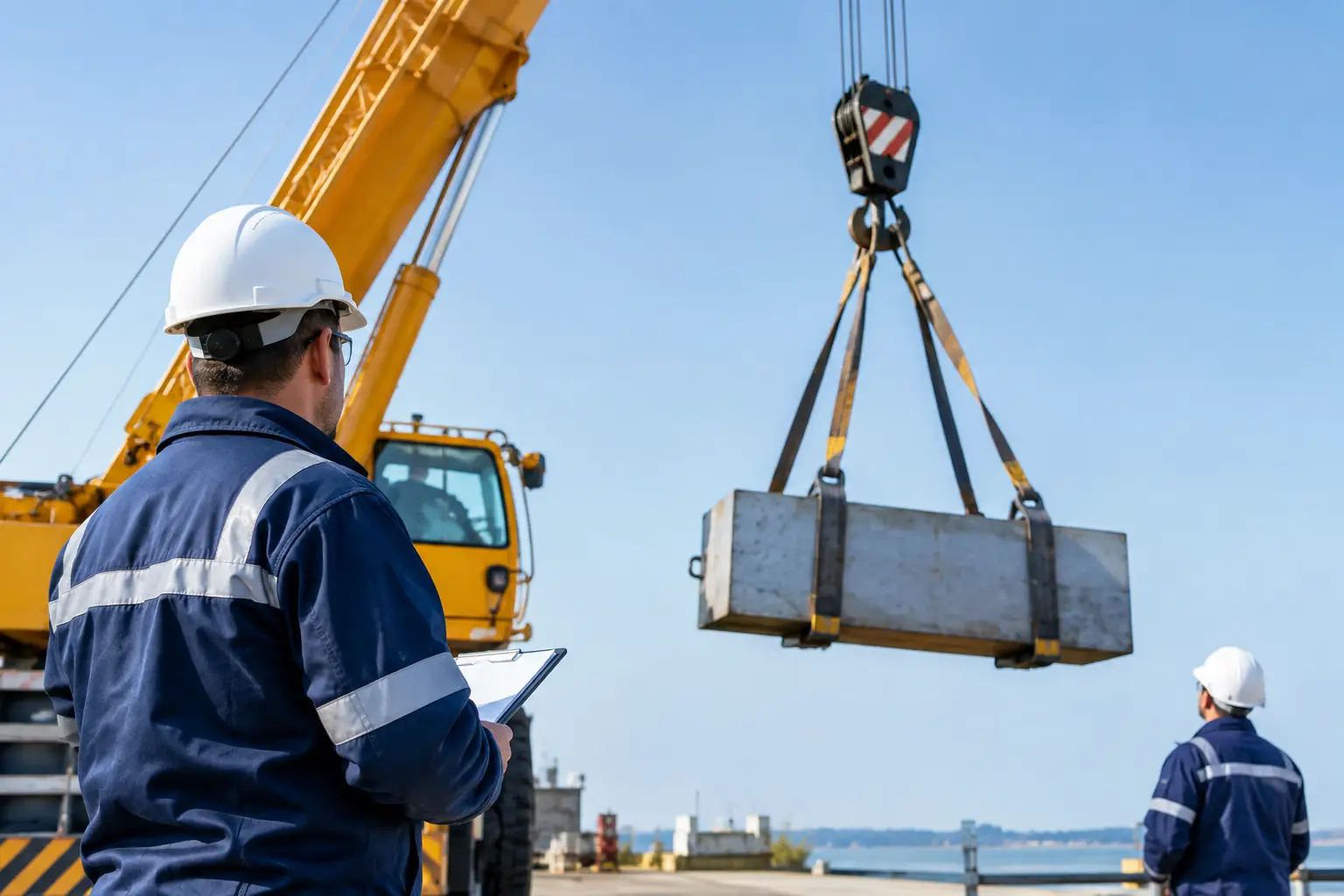
A crane can appear serviceable during routine lifting while a developing fault remains hidden in its hoist, brake, structure, runway, or safety devices. Crane load testing provides controlled evidence that the complete lifting system can handle its intended duty before it is placed into service, returned after repair, or accepted following modification. For plant and warehouse teams, it is not simply a compliance exercise. It is a practical check on safety, uptime, and the condition of a valuable production asset.
The test must be planned around the actual crane, its rated capacity, lifting configuration, workplace conditions, and applicable requirements. A properly executed test confirms performance without creating unnecessary risk to personnel, equipment, or the facility.
What Crane Load Testing Verifies
Load testing is a controlled examination of a crane or hoisting system while it handles a defined test load. The purpose is to assess how the equipment performs under load, not merely whether the hook can be raised and lowered. Depending on the equipment type and test scope, the process may evaluate the hoist, brakes, limit switches, controls, wire rope or chain, hook block, structure, trolley travel, bridge travel, runway, and supporting arrangements.
A test may be required for a newly installed overhead crane, gantry crane, jib crane, monorail hoist, winch, or other lifting machinery. It is also commonly considered after a major repair, structural alteration, capacity change, relocation, replacement of critical components, overload incident, or extended period out of service.
The exact acceptance criteria are not universal. They depend on the crane manufacturer’s instructions, the equipment design, the type of repair performed, site risk controls, and the regulations or inspection requirements that apply at the facility. This is why a generic test procedure is not a substitute for engineering review. Applying an unsuitable test load or testing method can impose loads that the crane system, building steel, runway, or test rigging was never designed to sustain.
Load Testing Is More Than Applying Weight
The visible part of a test is often the test load hanging from the hook. The most important work, however, takes place before the lift begins. A competent team needs to establish what is being tested, why it is being tested, and whether every part of the load path is suitable.
For an overhead traveling crane, the load path can extend from the hook and hoist through the trolley and bridge, into the end trucks, runway beams, runway supports, and building structure. A crane may perform adequately while the runway shows alignment problems, loose connections, or signs of fatigue. Conversely, a sound crane can be affected by poor runway condition. The inspection and test plan should consider the system as a whole.
Pre-test inspection normally checks the equipment’s identification and rated capacity, visible structural condition, safety labels, hook condition, reeving, ropes or chains, lubrication, electrical supply, pendant or radio controls, brakes, travel mechanisms, and safety devices. Any defect that could affect safe operation should be addressed before testing begins. Testing a known-defective crane does not make the defect acceptable.
Test weights must also be verified. Water bags, calibrated test weights, or other approved methods may be used, but the actual load must be known and controlled. The lifting beams, slings, shackles, and attachment points used to handle the test load require their own capacity confirmation and inspection. Improvised test arrangements are a frequent source of unnecessary risk.
A Safe Crane Load Testing Process
A practical test plan starts with a site assessment. The testing party should confirm the location, access route, available headroom, clear travel path, floor loading, exclusion zone, and how the test load will be introduced and removed. Operations around the crane should be coordinated so that people, production equipment, and stored materials are not exposed to a suspended-load hazard.
Define the scope before mobilization
The scope should state the equipment identification, rated capacity, proposed test load, test location, required motions, inspection points, personnel responsibilities, and acceptance criteria. It should also identify whether the test includes rated-load operation, proof loading, functional testing, or a combination of these activities.
This distinction matters. Functional testing confirms that motions and devices operate as intended. Proof testing may apply a specified load to demonstrate structural and mechanical integrity. The test requirement may differ for a new installation versus a hoist that has received a brake adjustment or rope replacement. More testing is not automatically better if it is not technically justified.
Establish control of the work area
Only essential personnel should be within the controlled test zone. The team needs clear communication, a designated person in charge, and a planned response if abnormal movement, noise, brake slip, electrical fault, or structural concern is observed. No person should stand beneath a suspended test load or place any part of their body where it could be trapped by crane movement.
The crane operator must be qualified for the equipment and familiar with the selected controls. Where a radio control is used, the team should confirm battery condition, emergency-stop function, and communications before the load is suspended.
Apply the load gradually and observe behavior
The load should be taken up slowly to confirm balance, rigging engagement, and brake holding ability. The test team observes for abnormal deflection, unexpected vibration, gear noise, rope tracking issues, fluid leaks, overheating, control irregularities, or signs of movement at structural connections.
Where travel testing is included, the crane should move through the required path at controlled speed while maintaining adequate clearance. For overhead cranes, this may include bridge and trolley movement to positions that meaningfully assess runway and crane behavior. It should never involve abrupt starts, stops, side pulling, or shock loading intended to make the test more demanding. Those practices do not demonstrate competence or safety. They introduce uncontrolled forces that can damage equipment.
Verify protective devices and holding performance
A crane’s capacity is only one part of safe operation. Upper-limit devices, lower-limit arrangements where fitted, emergency stops, overload protection, brakes, and control functions may need verification as part of the planned scope. Testing these devices should follow an approved method that avoids bypassing safeguards or creating a collision risk.
Brake performance deserves close attention. A load that drifts, slips, or cannot be held securely is an immediate concern. The response is to lower the load safely, isolate the equipment as necessary, identify the cause, and repair or adjust the system under competent supervision. Continuing a test in the hope that the condition will improve is not an acceptable decision.
Common Issues Revealed During Testing
Crane load testing can expose conditions that are not obvious during no-load operation. These include brake wear or incorrect adjustment, hoist gearbox noise, rope damage or poor spooling, hook latch defects, travel misalignment, control faults, loose fasteners, excessive structural deflection, and weak or damaged runway components.
Not every observation means that the crane has failed. A measured amount of deflection, for example, may be expected within the design parameters. The question is whether the observed behavior is consistent with the crane design and the applicable acceptance requirements. This is where experienced engineering judgment is essential. Decisions should be based on documented measurements, inspection findings, and equipment information rather than visual impression alone.
Facilities should also recognize the operational trade-off. A planned test may require a temporary shutdown and production coordination, but postponing it after a major repair or incident can expose the business to a longer and more costly interruption. A controlled maintenance window is generally easier to manage than a crane failure, damaged load, or workplace injury.
Documentation Turns a Test Into an Asset Record
A useful test record should identify the crane, location, date, rated capacity, test load, test method, inspection findings, functions tested, personnel involved, and result. It should record any corrective action required and clearly state whether the equipment is approved for return to service, restricted, or kept out of service pending repair.
This documentation supports maintenance planning as well as audit and safety requirements. Repeated observations across inspections can help a maintenance team spot patterns, such as recurring brake adjustment, uneven wheel wear, rope deterioration, or runway alignment concerns. That information allows repairs to be scheduled before an issue becomes a breakdown.
For custom lifting systems, records are particularly valuable because the design may incorporate site-specific dimensions, duty cycles, controls, or load-handling attachments. Keeping equipment data, drawings, service history, and test reports together gives future maintenance teams a reliable basis for decisions.
Choosing the Right Technical Partner
The right provider approaches crane load testing as part of the equipment lifecycle, not as an isolated certificate. They should understand the crane design, site conditions, lifting duty, relevant test requirements, rigging arrangements, and potential impact on the supporting structure. They should also be able to address findings through repair, spare-parts support, adjustment, or practical recommendations.
MFEI supports industrial lifting systems with engineering, installation, service, maintenance, and parts capability, helping facilities make testing outcomes actionable rather than leaving them with an unresolved report. For site managers, that continuity can reduce the time between identifying a defect and returning equipment to safe operation.
A well-planned test does more than confirm a number on a nameplate. It gives the people responsible for production and maintenance a clearer view of how their lifting equipment will perform when the next critical load is on the hook.
3 responses to “Crane Load Testing: A Practical Safety Guide”
[…] Load testing should follow the applicable regulations, approved procedures, equipment manufacturer requirements, and site rules. The test load, test method, acceptance criteria, and competent persons involved should all be defined before the lift begins. Never treat a load test as a general demonstration. The area must be controlled, the load must be stable, and personnel must remain clear of suspended loads. […]
[…] an afterthought. Functional checks, motion verification, limit-device testing, brake checks, and load testing where required help confirm that the crane performs as intended before it returns to normal […]
[…] raising the load fully, take up slack slowly and conduct a trial lift just clear of the supporting surface. Watch for shifting, slipping, unequal sling tension, or […]