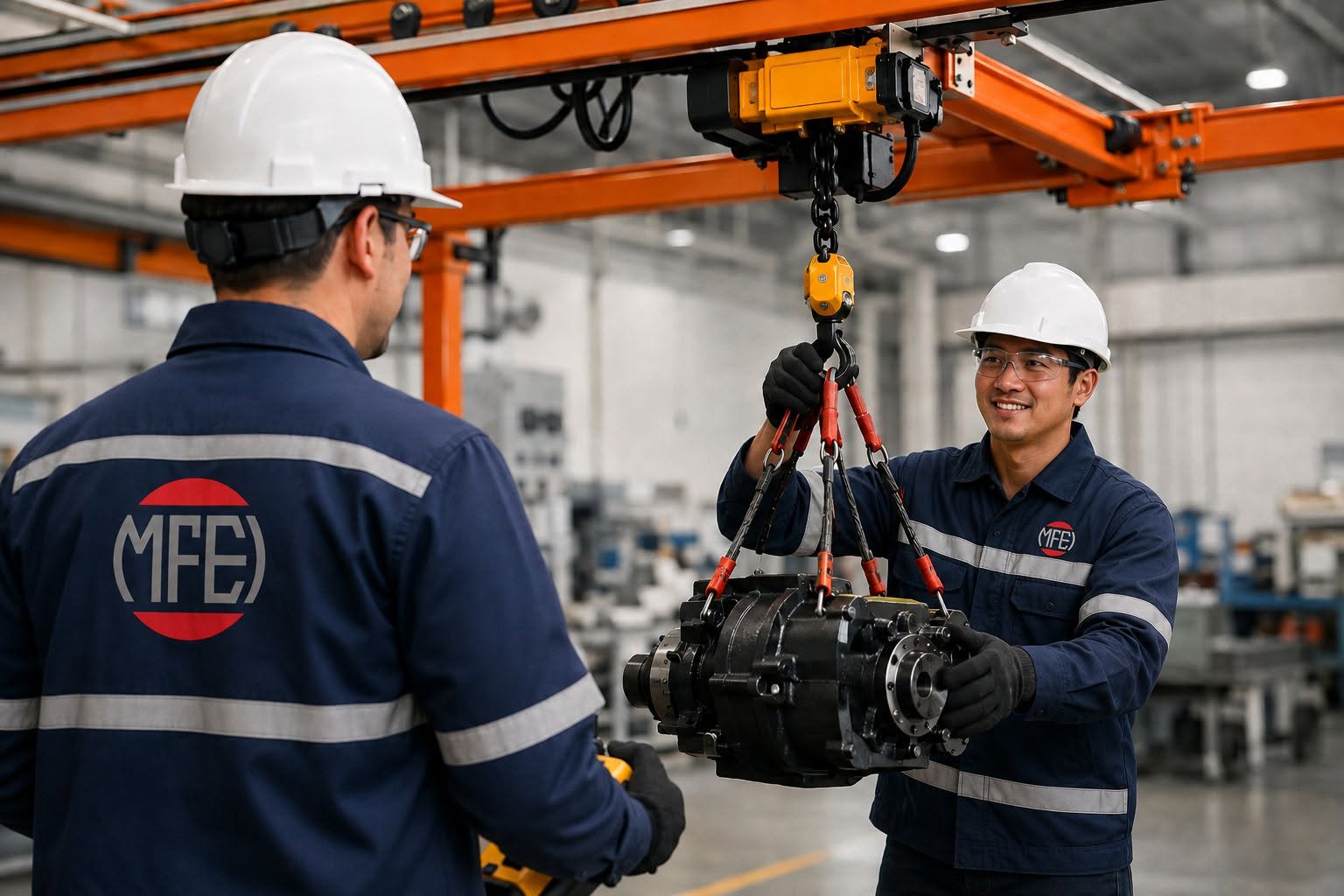
A component that must be lifted, shifted a few feet, accurately aligned, and lowered into place can create more operator fatigue than a much heavier load moved only occasionally. That is where workstation crane ergonomic lifting delivers value. It brings the lifting device closer to the work, allowing operators to handle repetitive loads with less reaching, twisting, carrying, and manual force.
For plant and warehouse managers, ergonomics is not a separate concern from productivity. Poor manual handling can slow assembly, increase damage risk, cause inconsistent positioning, and expose employees to avoidable strain. A properly engineered workstation crane supports the operator while keeping the workflow moving at a practical pace.
Why repetitive lifting needs a different solution
A forklift, overhead crane, or pallet jack may be appropriate for transporting heavy materials across a facility. They are not always the best answer for frequent, short-distance lifting at a single workstation. When an operator repeatedly lifts molds, fabricated parts, cartons, fixtures, tools, or assemblies, the issue is often not maximum load capacity. It is the combination of repetition, awkward posture, travel distance, and precise placement.
Manual lifting creates variability. One employee may be able to handle a part comfortably, while another must bend, pull, or pause to control it. Even light items become difficult when they are bulky, hot, sharp-edged, unstable, or handled hundreds of times per shift. A workstation crane converts that physical effort into a controlled lifting motion.
The goal is not simply to suspend a load. The goal is to make the load easy to reach, guide, position, and release within the operator’s normal work zone. That distinction should shape every design decision.
How workstation crane ergonomic lifting improves operations
A workstation crane typically combines a light-duty bridge, monorail, jib, or enclosed track system with a hoist and an appropriate lifting attachment. Installed near the point of use, it can cover a production cell, machining station, packing area, maintenance bay, or loading position without occupying valuable floor space.
The ergonomic benefit begins with reducing manual force. Rather than carrying a part from a pallet to a fixture, the operator uses the hoist to support the weight. Rather than reaching overhead or bending to pick up a component, the load can be presented at a more suitable height. The operator remains responsible for guiding and positioning, but no longer has to absorb the full weight of the workpiece.
This also improves repeatability. A well-positioned crane runway and hoist travel path allow the same component to move between the same locations every cycle. Operators can maintain better control during loading, assembly, inspection, or unloading. In processes where precise placement matters, reduced load swing and smoother movement can also help protect parts, jigs, machinery, and finished surfaces.
Ergonomic lifting can contribute to higher throughput, but only when the system follows the actual process. A crane that requires an operator to walk around an obstruction, manually rotate a difficult part, or wait for a shared lifting device may transfer the problem rather than solve it.
Design starts with the task, not the crane capacity
Selecting a workstation crane solely by the heaviest load is a common mistake. Safe working load is fundamental, but it is only one part of a fit-for-purpose system. The engineering assessment should examine how the material enters the workstation, where it must travel, how often the lift occurs, and how it must be presented to the next operation.
Load characteristics and handling frequency
The actual lifted weight should include the workpiece plus any fixture, hook, clamp, vacuum lifter, lifting beam, or custom attachment. Load dimensions and center of gravity are equally important. A long or off-center component may require better load control than a compact item of the same weight.
Frequency matters because a lifting solution for ten lifts per day may not suit a process that performs ten lifts per hour. High-cycle applications need equipment selected for the duty, reliable components, and a maintenance plan that protects availability. The operator’s time at the station should also be considered. If the worker must continuously use both hands for assembly, the lifting attachment may need to hold the load securely while allowing safe access to the task.
Reach, travel, and operator posture
Crane coverage should match the practical work envelope, not just the drawing dimensions of the area. The operator should be able to bring the load from pickup to placement without excessive stretching, pulling, or side loading. Crane rails placed too high can make the hoist control difficult to reach. Rails placed too low may interfere with equipment, doors, or headroom.
The preferred lifting height depends on the operation. A component being loaded into a machine may need to be held at waist height before final insertion. A packing operation may require adjustable height to suit different carton or pallet levels. In many cases, the best ergonomic outcome comes from pairing the crane with adjustable worktables, fixtures, or material presentation equipment.
Hoist and control selection
A hoist should provide smooth, predictable lifting and lowering. For frequent handling or delicate positioning, variable speed control may be worthwhile. It can reduce abrupt starts and stops, limit load swing, and give the operator better control near the final placement point.
The control arrangement also affects usability. A pendant control must be positioned where it can be reached without forcing an awkward posture. Some applications benefit from a tool balancer, articulated arm, or specialized manipulator rather than a conventional hook hoist. The correct choice depends on whether the operator must only lift a load or also rotate, tilt, orient, and accurately mate it with another part.
Choose the crane configuration around the workstation
Jib cranes are often effective where lifting is concentrated around one machine, bench, or loading point. They provide localized coverage and can be wall-mounted, column-mounted, or installed with a freestanding support structure where building support is unsuitable.
Monorail systems are useful when the load follows a consistent linear path, such as from a conveyor to a workstation or between sequential process stations. They can be a cost-conscious choice when lateral movement is unnecessary.
For rectangular work areas that need broad coverage, a light-duty overhead workstation bridge crane can provide travel in two directions. This configuration is particularly useful for moving materials between storage racks, worktables, machines, and inspection points within a cell. It also avoids introducing floor-based handling equipment into busy pedestrian areas.
Each option has trade-offs. A jib crane may be economical and simple, but it cannot serve an area outside its radius. A bridge crane offers wider coverage, but installation requires careful coordination with building structure, utilities, fire protection, access routes, and future equipment changes. An engineering review should identify these constraints before a system is specified.
Safety is built into daily usability
Ergonomic equipment must remain safe under real production conditions, not only during commissioning. Clear load ratings, appropriate end stops, properly selected lifting attachments, control cable management, and safe operating clearances all contribute to reliable use. Operators should understand the lift path, attachment method, load stability, and the limits of the equipment.
Attention should also be given to the pickup and release points. A crane cannot eliminate risk if workers still need to place hands near pinch points, manually steady an unstable load, or work below a suspended component. Custom fixtures, lifting beams, clamps, and vacuum solutions can improve both control and operator separation from the load, provided they are designed for the application and maintained correctly.
Routine inspection and service are equally important. Wear in hoist components, damaged pendant cables, misaligned rails, loose fasteners, or degraded lifting accessories can affect safe operation and uptime. Local spare-parts access and planned maintenance help prevent a small issue from becoming a production interruption.
A practical path from problem area to installed solution
The most useful starting point is a site observation of the existing task. Record the load weight and dimensions, number of lifts per shift, lift height, travel path, worker positions, obstructions, and required placement accuracy. It is also useful to ask operators where the task feels difficult. They often identify the moments when the load is hardest to control or when the process forces an awkward movement.
From there, the lifting system can be designed around the available space, structural conditions, workflow, and budget. A practical proposal should account for installation access, power supply, support steel if required, future maintenance access, and the possibility of changes in product mix. Buying more capacity or coverage than the process needs can add unnecessary cost. Under-specifying the system can create operational frustration from the first week of use.
MFEI approaches these projects as full-lifecycle lifting solutions: assessing the task, engineering equipment around site constraints, installing the system, and supporting its service and spare-parts needs afterward. That continuity matters when a workstation crane becomes part of a critical production process rather than an occasional tool.
The best ergonomic lifting improvement is usually found in one repeatable task that employees have learned to work around for too long. Measure that task carefully, involve the people who perform it, and design the lift so the work feels controlled rather than physically demanding.