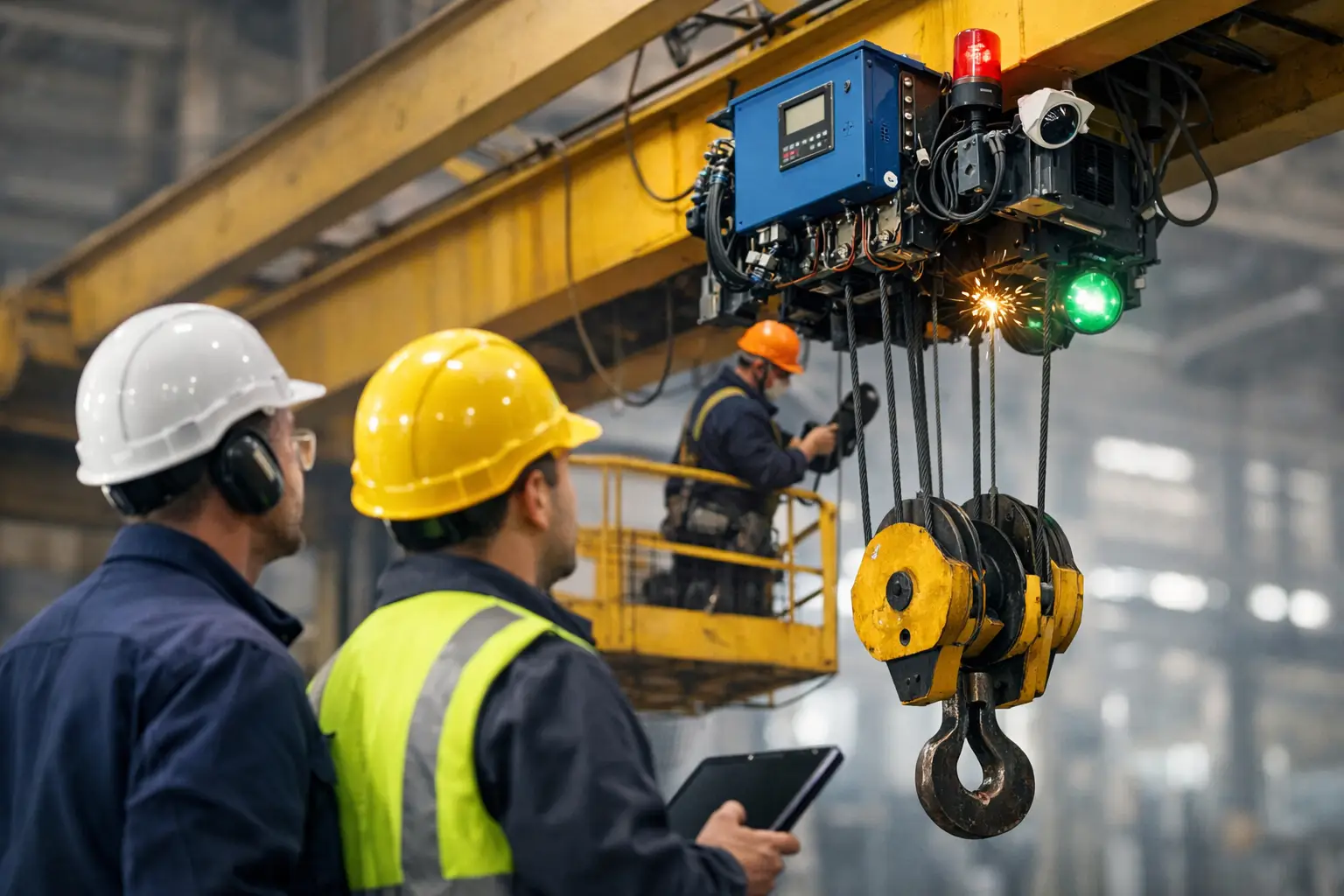
A crane does not need to fail outright to become a safety concern. Intermittent limit-switch faults, poor pendant response, worn brakes, blind lift zones, and obsolete controls can all leave an operating team relying on workarounds. Crane modernization safety upgrades address these risks before they become a dropped-load event, injury, or extended production stoppage.
For plant and warehouse managers, modernization is often the practical middle ground between continued patch repairs and full crane replacement. The right scope preserves sound structural assets while improving how the crane lifts, travels, stops, communicates, and protects the people working around it. The wrong scope, however, can add features without resolving the actual risks on the shop floor. A useful modernization plan begins with the equipment, the load path, and the real duty cycle.
Start With a Site-Specific Risk Assessment
Modernization should not begin with a catalog of accessories. It should begin with an engineering assessment of the crane’s condition and operating environment. This includes the bridge, runway, hoist, trolley, electrical supply, controls, wire rope or chain, hook block, brakes, and end stops. The assessment should also review how operators use the crane during normal production, changeovers, maintenance work, and infrequent heavy lifts.
The same crane model can require very different upgrades in a fabrication bay, a warehouse loading area, or a high-cycle production line. A crane that makes repetitive short lifts may place more demand on braking and control response than a crane used occasionally for maintenance. A crane operating near people, machinery, racking, or process equipment may need better travel control and collision protection even if its hoist is mechanically sound.
A review of inspection findings and service history is equally valuable. Repeated contactor failures, brake adjustments, overload incidents, misalignment, or operator complaints are not isolated inconveniences. They are evidence of where the system is losing reliability or operating margin. By identifying root causes before specifying equipment, a facility can direct its budget toward upgrades that materially improve safety and availability.
High-Value Crane Modernization Safety Upgrades
The most effective upgrades are those that remove a known hazard or improve control at a critical point in the lift. They must be matched to the existing crane design and verified during installation and commissioning.
Overload Protection and Load Monitoring
Overloading can damage the hoist, rope, hook assembly, structure, and runway while exposing personnel to serious risk. An overload protection device helps prevent lifts beyond the rated capacity by monitoring load and restricting further hoisting when a set limit is reached. Depending on the application, a visible load display can also give operators and supervisors clearer confirmation of the load being handled.
These systems are particularly useful where loads vary, lifting fixtures are changed frequently, or multiple teams use the same crane. Calibration and periodic testing matter. A load-monitoring device that is not maintained or is bypassed does not provide meaningful protection.
Upper and Lower Limit Protection
Hoist limit switches prevent overtravel at the upper and lower ends of hook travel. A properly arranged upper limit is essential for reducing the chance of two-blocking, where the hook block contacts the hoist body. Lower-limit protection helps prevent the rope from being run out beyond its safe working condition.
For older equipment, a modernization review should confirm that limit devices are correctly located, functional, and suitable for the hoist arrangement. Where the consequences of overtravel are significant, an additional independent upper limit may be appropriate. The exact arrangement depends on the equipment design, operating practice, and applicable requirements.
Brake Improvements and Condition Monitoring
A hoist brake is a primary safety component, not simply a wear part. It must hold the rated load securely and release predictably. Travel brakes also affect stopping distance and positioning, especially on cranes serving congested work areas.
Brake modernization may involve replacing worn assemblies, upgrading brake components, improving adjustment access, or adding monitoring where the control system supports it. The value is not only stronger holding performance. Consistent braking improves operator confidence and reduces the temptation to compensate for drift, delayed stopping, or inconsistent response through unsafe handling practices.
Variable-Frequency Drives and Better Motion Control
Many legacy cranes operate with abrupt starts and stops. This can create load swing, place shock loads on mechanical components, and make precise positioning difficult. Variable-frequency drives provide controlled acceleration and deceleration for hoist, trolley, and bridge motions when correctly selected and programmed.
The benefit is especially clear where loads must be positioned near equipment, operators, or tight storage areas. Smoother motion can reduce product damage and mechanical stress while supporting safer handling. However, drive upgrades require careful integration. Motor suitability, braking method, electrical supply quality, control logic, and emergency-stop performance must all be evaluated rather than assumed.
Radio Controls and Improved Pendant Stations
Control upgrades can improve the operator’s line of sight and reduce exposure to suspended loads. A radio remote allows an operator to stand in a safer position, provided the work area, communication practices, and control permissions are well managed. Modern pendants can also improve button layout, labeling, emergency-stop access, and ergonomics.
Radio control is not automatically safer in every setting. In busy areas, the operator still needs a clear view of the load path, and facilities must prevent unauthorized use. Features such as unique pairing, controlled start-up, warning devices, and defined operating procedures help make remote operation dependable.
Anti-Collision, Zoning, and Travel Limits
Where two or more cranes share a runway, or where a crane travels near fixed obstacles, anti-collision systems can help maintain safe separation. Travel limits and zoning can restrict motion into protected areas above machinery, workstations, or restricted spaces.
These systems need accurate site measurement and realistic operating logic. A poorly planned zone can interfere with production, encourage bypassing, or create unexpected movements. A well-engineered system balances protection with the actual material flow of the facility.
Modernize the Electrical System, Not Just the Controls
A new pendant or drive will not correct deteriorated wiring, undersized protection, damaged festoon systems, or obsolete panels. Electrical modernization should review the complete power and control path, including isolators, panels, contactors, relays, cabling, grounding, collectors, and cable-management systems.
Replacing aging components with serviceable, supported parts can reduce unplanned downtime and shorten repair time. It also gives maintenance teams clearer documentation, better fault diagnosis, and improved access to spare parts. For facilities where crane availability affects an entire production cell, this may be one of the strongest commercial cases for modernization.
A phased approach is often sensible. Critical safety devices and failing electrical components can be addressed first, followed by motion control, automation interfaces, or monitoring functions as budget and shutdown windows allow. The sequence should be based on risk and operational impact, not merely on which component is easiest to replace.
Installation, Testing, and Training Determine the Result
Safety upgrades are only as effective as their installation and commissioning. Before work begins, the project team should define the shutdown plan, access requirements, lifting arrangements, electrical isolation, and any temporary production controls. Installation must protect the existing crane structure and avoid introducing new issues such as cable interference, incorrect sensor alignment, or inaccessible service points.
After installation, the equipment should be inspected, function-tested, and load-tested as applicable to the scope and governing requirements. Control directions, limit functions, brake operation, emergency stops, warning devices, and interlocks should be verified under real operating conditions. Updated electrical drawings, manuals, inspection records, and maintenance instructions should be handed over to the facility team.
Operator and maintenance training should be part of the project, not an afterthought. Operators need to understand what has changed, what alarms or displays mean, and when to stop work. Maintenance personnel need clear guidance on inspection points, adjustments, troubleshooting, and replacement parts. This is how an upgrade becomes part of daily safe operation rather than a feature that gradually falls out of use.
Choose Upgrades That Support the Crane’s Remaining Life
Not every older crane is a good candidate for extensive modernization. If the main structure, runway, hoist gearing, or mechanical condition has reached the end of its economical service life, replacement may offer better long-term value. Conversely, a structurally sound crane with obsolete controls and manageable wear can often be upgraded effectively at a lower cost and with less disruption.
An experienced lifting-equipment engineering partner can help compare those options honestly. At MFEI, modernization work is approached as a lifecycle decision: assess the existing equipment, define the safety and uptime priorities, select fit-for-purpose components, and plan maintenance support after commissioning.
The best next step is not to buy every available feature. It is to identify the point in your lift where control is weakest, exposure is highest, or downtime is most costly, then engineer an upgrade that makes that point safer and more dependable.
One response to “Crane Modernization Safety Upgrades That Pay Off”
[…] the scope of work. If these elements remain suitable for the intended loads and service duty, modernization of the hoist and controls may deliver the most cost-effective […]