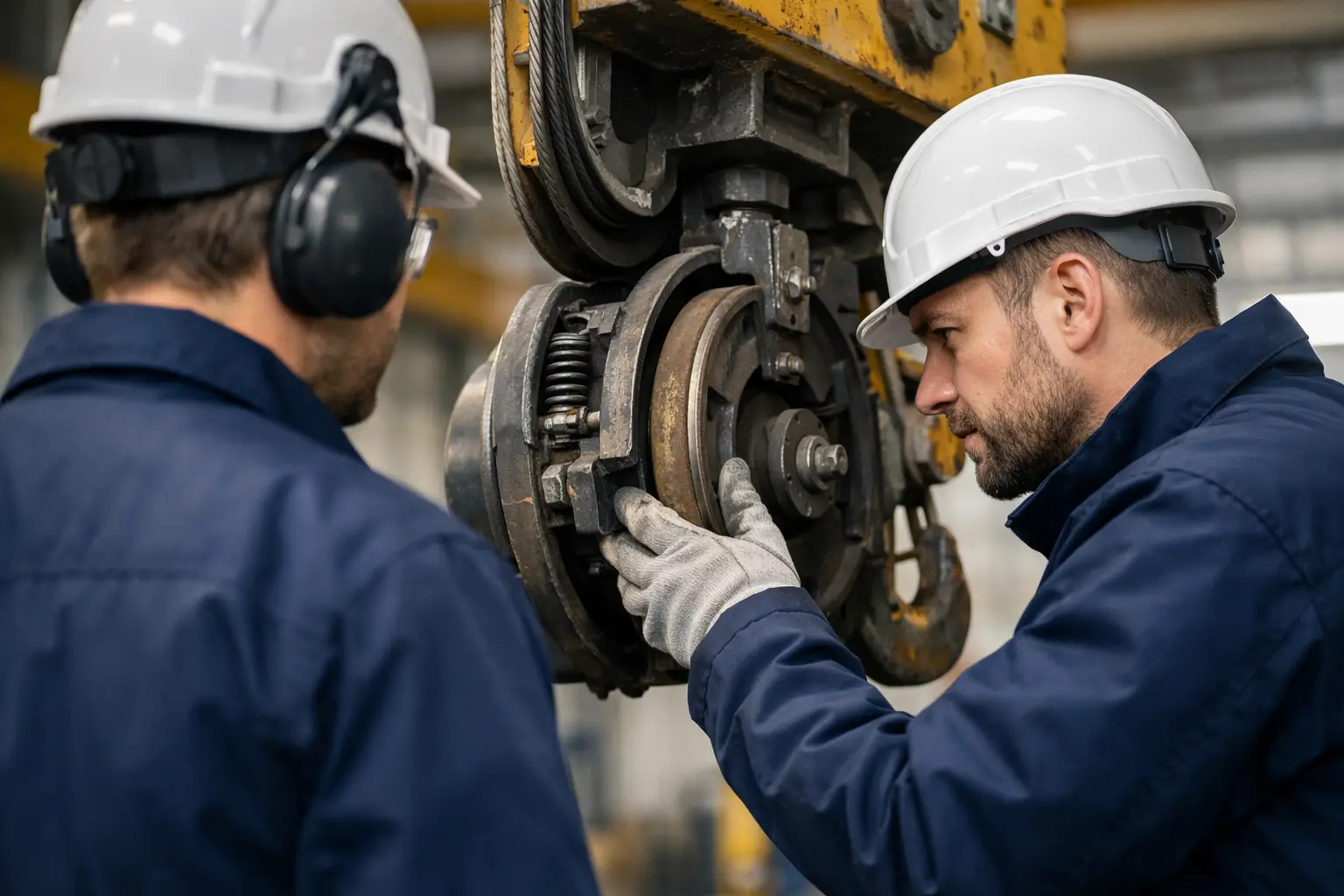
A crane brake that slips, drags, releases slowly, or fails to hold a suspended load is not a minor maintenance concern. It is a direct safety and uptime risk. When plant teams ask what causes crane brake failure, the answer is rarely one isolated defect. Brake performance depends on the condition of the friction surfaces, mechanical linkage, electrical controls, load handling practices, and maintenance discipline.
For overhead cranes, hoists, winches, and other lifting machinery, the brake is a holding and control device. It must apply reliably when power is removed and release fully when motion is commanded. A small loss of braking torque can become significant when lifting capacity, duty cycle, or stopping distance is involved.
What Causes Crane Brake Failure in Service?
Crane brake failure usually develops progressively. Operators may first notice load drift, longer stopping distances, abnormal noise, overheating, a burning smell, or hesitation before travel or hoisting begins. These symptoms should be investigated promptly rather than treated as normal wear.
The most common causes fall into eight connected areas.
1. Worn or contaminated friction material
Brake linings, discs, and drums wear through normal use. Once friction material is below its allowable thickness, the brake may no longer generate the torque required to hold the rated load. Wear can be accelerated by frequent starts and stops, repeated inching, heavy-duty lifting cycles, or an application that was not properly matched to its operating duty.
Contamination is equally serious. Oil or grease from a leaking gearbox, hydraulic fluid, moisture, dust, and chemical residue can reduce friction dramatically. A brake can appear mechanically intact but still slip because its contact surfaces are contaminated. Cleaning alone may not always restore performance, particularly if oil has penetrated the lining material.
2. Incorrect brake adjustment
A properly designed brake still requires correct adjustment. Excessive air gap, incorrect spring compression, poor shoe-to-drum contact, or uneven lining clearance can reduce braking force and create inconsistent operation. Adjustment errors are common after component replacement, emergency repairs, or maintenance performed without the correct specifications.
Over-adjustment brings a different problem. If a brake does not release fully, it can drag during operation. This generates heat, wears the lining and drum, increases motor load, and may eventually damage coils or mechanical components. The objective is not simply a tighter brake. It is a brake set to the manufacturer’s required torque and clearance.
3. Weak springs or damaged mechanical linkage
Many industrial crane brakes are spring-applied and electrically released. The springs provide the force that applies the brake when power is removed. Springs can weaken with age, corrosion, repeated heat exposure, or fatigue. Pins, levers, pivots, bushings, and linkages can also wear, seize, bend, or develop excessive play.
These defects may cause the brake shoes to apply unevenly or prevent the full spring force from reaching the braking surface. Corroded pivot points are especially common in humid, dusty, or outdoor environments. A visual inspection is useful, but it should be accompanied by functional testing to confirm the brake applies and releases through its complete travel.
4. Electrical release faults
In an electromagnetic brake, the coil and control circuit release the brake during operation. Low voltage, a damaged coil, loose wiring, poor terminal connections, faulty rectifiers, contactor problems, or control-panel faults can prevent a complete release. The result may be brake drag, chattering, delayed release, or a crane that will not move smoothly.
Electrical issues can also create unsafe braking behavior during a power interruption or control fault. A brake system should fail to its safe applied condition, but the system must be evaluated as a whole. Incorrect wiring changes, unsuitable replacement components, or bypassed interlocks can compromise intended safety behavior.
5. Overheating from excessive duty or brake drag
Heat shortens brake life. A brake that is required to stop too frequently, control loads beyond its designed duty, or operate while partially engaged can overheat quickly. Heat can glaze friction material, distort drums or discs, weaken springs, and damage insulation in electromagnetic coils.
The underlying cause may be operational rather than purely mechanical. For example, using the hoist brake to compensate for poor speed control, frequent plugging, or repeated inching under high load creates a braking demand the equipment may not have been designed to handle. Reviewing actual operating patterns is often as valuable as inspecting the brake itself.
6. Overloading and poor load control
A crane brake is designed around the lifting system’s rated capacity and configuration. Lifting beyond the rated load, side pulling, shock loading, sudden starts, or lowering an uncontrolled load can exceed its available braking torque. Even if an overload does not cause an immediate failure, it can accelerate wear and leave hidden damage in the brake, gearbox, rope, hook block, or supporting structure.
Load control matters during normal operation as well. An operator who moves a load abruptly can create dynamic forces much greater than the static weight shown on a load chart. Clear operating procedures, trained operators, functional limit switches, and correct lifting methods reduce these avoidable stresses.
7. Environmental corrosion and ingress
Malaysia’s humid industrial conditions can expose lifting equipment to moisture, condensation, airborne dust, corrosive fumes, and temperature changes. Facilities handling chemicals, metal finishing, marine-related cargo, cement, food products, or outdoor materials face additional environmental demands.
Corrosion can affect brake springs, fasteners, pivots, electrical enclosures, terminals, and friction surfaces. Dust buildup may obstruct linkage movement or retain moisture. Where the environment is severe, brake selection, enclosure protection, inspection frequency, and cleaning practices should be adjusted to the actual site conditions rather than treated as standard.
8. Deferred maintenance and unsuitable replacement parts
The final cause is often the one that allows all other issues to progress: deferred service. Brakes can deteriorate gradually without stopping production immediately, so inspections are sometimes postponed until the crane begins slipping or alarms occur. At that stage, the repair may involve more than a lining replacement.
Using non-matching linings, coils, springs, drums, or adjustment hardware can create further problems. A replacement part must suit the brake model, voltage, torque requirement, and duty cycle. A lower initial parts cost can be outweighed by repeat downtime, poor performance, and reduced equipment lifespan.
How Brake Failure Should Be Investigated
A sound investigation starts by making the crane safe and removing it from service where braking performance is in doubt. Do not attempt to prove holding capacity by exposing personnel or equipment to an uncontrolled suspended-load risk. Qualified technicians should isolate power, verify the condition of the brake assembly, and follow the equipment manufacturer’s inspection and testing requirements.
The assessment should cover friction thickness and condition, drum or disc wear, air gap, spring force, pivot movement, coil condition, supply voltage, wiring integrity, control response, and signs of heat or contamination. It should also review the crane’s operating history. A recurring brake issue may point to overloading, an unsuitable duty classification, improper control settings, or a design mismatch with the facility’s workflow.
For example, a hoist brake that repeatedly overheats may need more than another set of linings. The appropriate solution could involve correcting a dragging release mechanism, repairing a control fault, changing operating practices, or reviewing whether the hoist capacity and duty rating suit the application.
Preventing Brake Problems Before They Stop Production
Preventive maintenance should be based on equipment use and site risk, not only on a calendar interval. A lightly used workshop crane and a high-cycle production-line hoist should not receive the same inspection approach. Maintenance records should identify brake measurements, adjustments made, parts replaced, fault symptoms, and any changes in operating conditions.
Operators also play a practical role. They should report unusual stopping behavior, drift, noise, vibration, heat, or delayed release immediately. These early observations can prevent a minor adjustment or contamination issue from becoming a significant lifting-system repair.
At MFEI, effective crane service and maintenance begins with understanding how the equipment is actually used, the environment it operates in, and the consequences of downtime. A brake is a relatively compact component, but its condition influences every lift. Treating early warning signs as an engineering issue, rather than an inconvenience to work around, protects people, loads, and production continuity.
4 responses to “What Causes Crane Brake Failure? 8 Key Factors”
[…] Brake performance deserves close attention. A crane may travel and lift without obvious difficulty, yet a brake that does not hold or stop reliably can create a hazardous load-control event. Similarly, limit switches should be tested functionally, not merely inspected visually. Their purpose is to prevent overtravel and unsafe hoisting, so they must operate consistently under normal conditions. […]
[…] lifting applications, braking performance is non-negotiable. The primary brake must hold the rated load under the intended operating […]
[…] Brake performance deserves close attention. A load that drifts, slips, or cannot be held securely is an immediate concern. The response is to lower the load safely, isolate the equipment as necessary, identify the cause, and repair or adjust the system under competent supervision. Continuing a test in the hope that the condition will improve is not an acceptable decision. […]
[…] hoist brake is central to safe load holding. Changes in stopping distance, delayed engagement, unusual noise, […]