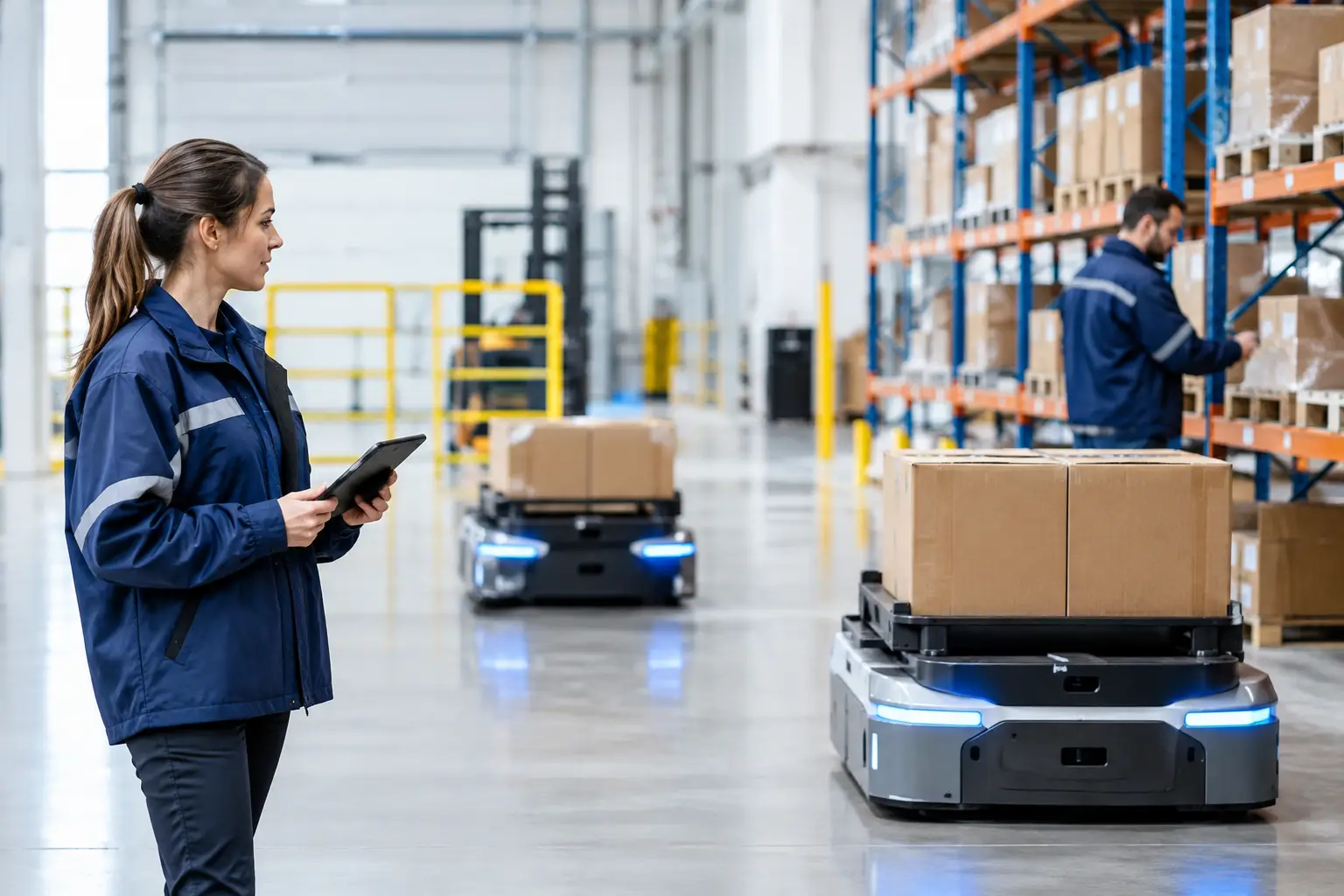
A production line loses more than minutes when a load waits for a forklift, an available operator, or a clear travel path. Automated material handling addresses those delays by coordinating how materials are lifted, transferred, positioned, and delivered through a facility. The right system can reduce manual handling, stabilize cycle times, and improve safety, but only when it is engineered around the actual load, process, building, and maintenance capacity.
For plant managers and project teams, automation is not a single purchase. It is a material-flow decision that affects throughput, operator safety, equipment access, utilities, maintenance planning, and capital cost for years to come.
What Automated Material Handling Means in Practice
Automated material handling uses equipment and controls to move materials with limited manual intervention. Depending on the application, that may include overhead cranes with automated travel functions, hoists with programmed positioning, conveyors, transfer systems, lift tables, automated storage interfaces, and sensors that confirm a load has reached the correct point.
The level of automation should match the process. A repetitive operation moving the same component between fixed stations may benefit from a fully programmed crane or transfer sequence. A workshop handling varied loads, shapes, and destinations may gain more from assisted lifting, variable-speed hoists, anti-sway controls, and clearly defined travel paths. In that environment, full automation can add cost and complexity without delivering a proportional operational benefit.
The objective is not to remove people from every movement. It is to remove unnecessary waiting, unsafe manual effort, inconsistent positioning, and avoidable handling damage.
Start With the Material Flow, Not the Equipment
A common mistake is selecting a crane, hoist, or conveyor before defining how materials move through the operation. Equipment capacity matters, but it is only one part of the engineering requirement. A 5-ton load, for example, may be straightforward to lift yet difficult to move safely if it has an offset center of gravity, requires precise placement, or must pass through a congested bay.
A sound assessment maps the full handling cycle: where the material enters, where it is picked up, where it must travel, how it is positioned, and what happens after it is released. It should also account for peak demand rather than average demand. A system that handles normal production well but creates a bottleneck during shift changes, maintenance shutdowns, or dispatch peaks will not deliver the expected return.
Questions That Shape the Design
Engineering teams should establish the load weight, dimensions, lifting points, center of gravity, handling frequency, travel route, required precision, and expected duty cycle. Building factors are equally important. These include runway availability, headroom, column spacing, floor loading, electrical supply, access for installation, and whether the system must operate around people or existing machinery.
The answers determine whether an overhead crane, jib crane, monorail, electric hoist, winch arrangement, conveyor interface, or a combination of systems is most practical. They also influence the appropriate controls, lifting attachments, safety devices, and maintenance access.
Where Automation Delivers the Strongest Value
Automation is most valuable where a handling task is repetitive, time-sensitive, hazardous, or difficult to perform consistently by hand. In manufacturing, this may involve feeding machines, transferring dies, moving fabricated assemblies, or positioning components for welding and assembly. In warehouses and logistics operations, the priority may be predictable movement between receiving, storage, packing, and dispatch areas.
For heavy or awkward materials, automation can improve quality as well as speed. Controlled lifting and positioning reduce the likelihood of impact damage, dropped loads, and misalignment at workstations. Features such as variable-speed control, load monitoring, limit switches, collision avoidance, and anti-sway functions can make movement more controlled, particularly in constrained production areas.
However, automation does not automatically increase output. If a downstream machine lacks capacity or an upstream process cannot supply material reliably, faster handling may simply move the bottleneck. The business case should therefore measure the entire process, not only the travel speed of a crane or hoist.
Safety Must Be Designed Into the Sequence
A material-handling system is safe only when its equipment, controls, operating procedures, and maintenance practices work together. Automated travel does not eliminate risk. It changes the risk profile and requires careful attention to exclusion zones, pedestrian routes, emergency stops, warning devices, load security, and clear operator authority.
The lifting arrangement deserves equal attention. A high-quality hoist cannot compensate for an unsuitable lifting beam, sling configuration, or attachment point. Loads need to remain stable throughout acceleration, travel, and placement. Where personnel work near the movement path, control logic should prevent unintended travel into restricted areas and provide a safe method to isolate the equipment for inspection or repair.
Training remains essential. Operators and maintenance personnel need to understand normal operation, manual override procedures, abnormal-load conditions, inspection requirements, and what to do when a sensor, limit, or control alarm is triggered. Automation should make safe work easier to repeat, not encourage workers to bypass safeguards when production pressure rises.
Design for Reliability and Service Access
The most productive system is not necessarily the one with the most advanced controls. It is the system that can operate consistently, be inspected efficiently, and be restored quickly when parts require replacement. This is particularly relevant for facilities where lifting equipment supports a critical production process.
Specify components based on duty classification and operating environment. Heat, dust, humidity, corrosive exposure, outdoor use, and high cycling all affect the choice of hoist, motor, brake, electrification method, enclosure rating, and control arrangement. A unit designed for occasional lifting may not withstand continuous production use, even if its rated capacity appears adequate.
Service access should be considered before installation. Can technicians reach the hoist, trolley, control panel, runway components, and safety devices without disrupting the entire facility? Are critical spare parts available locally? Is there a practical inspection and preventive maintenance schedule? These questions are commercially important because downtime costs often exceed the price difference between a basic installation and a properly engineered system.
MFEI approaches this lifecycle requirement through site assessment, customized engineering, installation, spare-parts support, and ongoing service and maintenance. For customers, the value lies in having a system designed with both daily operation and long-term maintainability in mind.
Build the Investment Case Around Measurable Results
A capital proposal for automated material handling should go beyond labor savings. In many facilities, the more meaningful gains come from reduced waiting time, fewer handling incidents, improved machine utilization, lower product damage, safer ergonomics, and better control over production flow.
Start with a baseline. Measure current cycle time, handling distance, labor involvement, delay frequency, damage or rework events, and unplanned equipment downtime. Then model the proposed future state using realistic assumptions about load frequency, operator interaction, planned maintenance, and peak-period demand.
It is also wise to compare phased automation with a full system installation. A facility may first install a properly sized crane runway and hoist system, then add positioning controls, sensors, or process integration as volumes grow. This approach can protect the initial budget while avoiding an installation that limits future improvement.
A Practical Path From Requirement to Operation
Successful projects begin with a site survey and a clear operating brief. From there, the engineering process should confirm structural and spatial constraints, select equipment suited to the application, define the control and safety philosophy, and plan installation around production needs.
Commissioning should test more than whether the equipment lifts a rated load. It should verify travel paths, positioning accuracy, limit operation, emergency functions, load-control behavior, communication between connected systems, and operator usability. Documentation, training, scheduled inspections, and a spare-parts strategy should be in place before the system becomes a critical part of production.
The best automated material handling solution is rarely the most elaborate one. It is the one that moves the right load, through the right path, at the right pace, with safety and serviceability built into every decision.