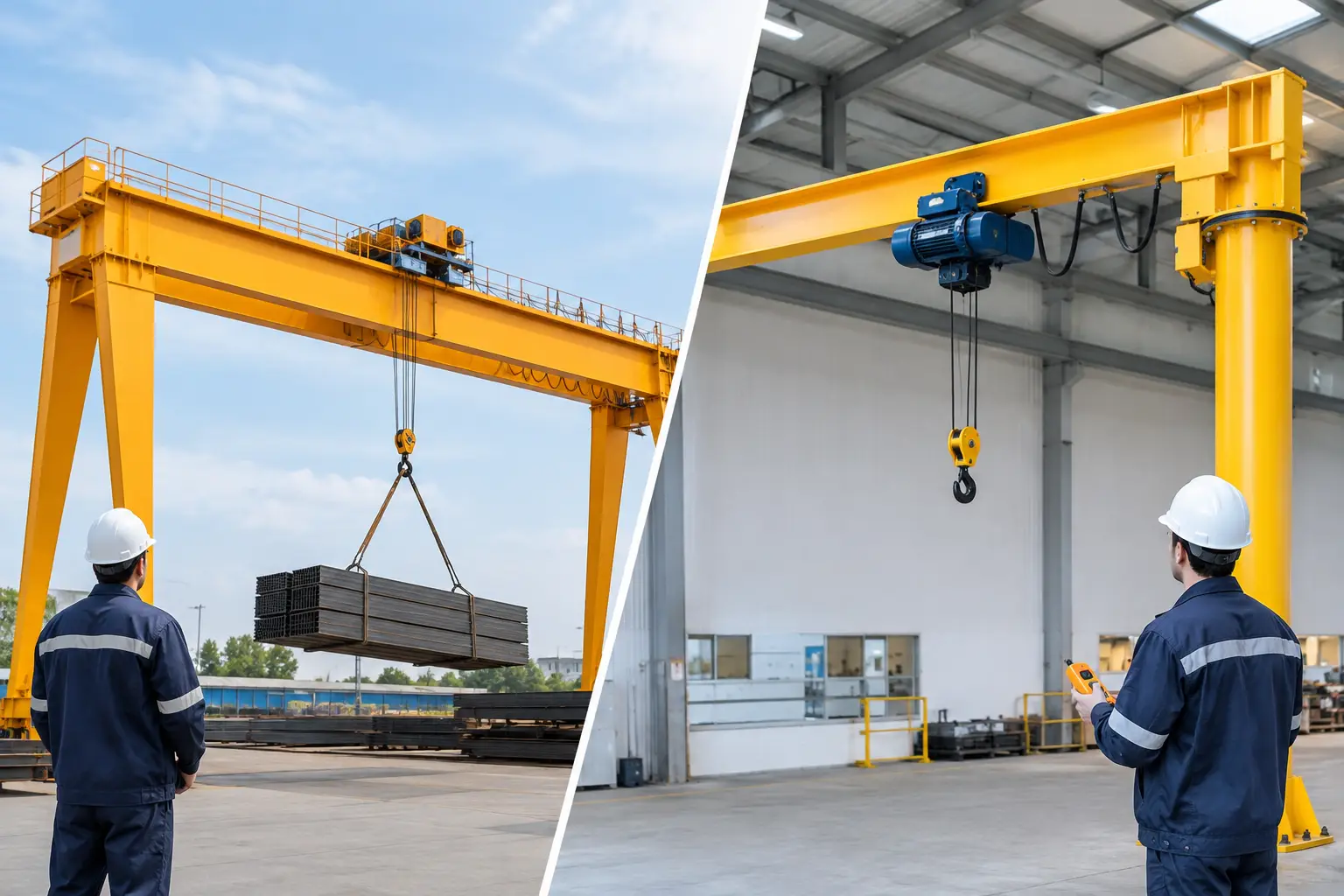
A gantry crane versus jib crane decision is usually made at the point where a manual handling problem starts affecting throughput, safety, or both. A maintenance team may need to remove motors repeatedly from the same machine. A fabrication shop may need to move steel sections across multiple workstations. Those are different lifting duties, and selecting the wrong crane type can leave valuable capacity unused or create costly installation work that does not solve the actual problem.
The right choice depends less on which crane has the higher stated capacity and more on the load path, the required working area, building constraints, frequency of use, and expected service life. A sound lifting solution starts with the work being performed, then matches the equipment to the facility and budget.
Gantry Crane Versus Jib Crane: The Basic Difference
A gantry crane carries its bridge and hoist on legs. Depending on the design, those legs may travel on floor-mounted rails, or the crane may be a portable unit with casters. The hoist moves along the bridge, while the gantry travels along its runway. This creates rectangular lifting coverage across a defined area.
A jib crane uses a horizontal boom, known as a jib, that rotates around a mast or wall-mounted pivot. The hoist travels along the jib arm, providing lifting coverage within a circular or semi-circular area. It is generally intended to serve a localized workstation, machine, loading bay, or maintenance zone.
Neither design is automatically better. A gantry crane is built around travel and broad coverage. A jib crane is built around quick, repeatable handling close to where people work. The operational pattern should make the choice clear.
When a Gantry Crane Is the Better Fit
A gantry crane is often suitable when loads must move across a wide floor area and the facility cannot support an overhead crane runway from its building columns. Because the crane carries its own legs, it transfers lifting and travel loads to the floor or rail foundation rather than relying on the roof structure.
Rail-mounted gantry systems are a practical option for production bays, precast yards, fabrication areas, and outdoor handling zones where loads follow a regular route. They can provide substantial capacity and span while keeping the area above the load clear of permanent building-mounted runway beams.
Portable gantry cranes serve a different need. A smaller adjustable gantry can be moved between work areas for intermittent maintenance, assembly, and equipment installation. It is useful where lifting points change and a fixed crane would be difficult to justify. However, portability should not be confused with unlimited flexibility. Floor condition, wheel loading, travel path, doorway clearance, and safe movement of a suspended load all require review.
Gantry cranes are typically favorable where the following conditions apply: the load must travel over distance, several workstations need to be served, the building structure is unsuitable for an overhead runway, or the application is partly outdoors. They can also be a sensible choice for leased premises when a self-supporting system is preferred over major structural modifications.
The trade-off is footprint. Gantry legs occupy floor space, and their movement can conflict with forklifts, pedestrians, stored materials, or fixed machinery. A rail-mounted system reduces steering concerns but requires accurate rail installation, suitable foundations, and regular alignment checks. A portable system avoids rails but needs clear travel routes and disciplined operating procedures.
When a Jib Crane Is the Better Fit
A jib crane is usually the more efficient answer for repetitive lifts within a compact area. Typical examples include feeding a machine tool, loading parts onto a workbench, lifting dies, handling pumps during maintenance, or transferring materials between a pallet and a production line.
The operator can bring the hook directly to the work area without waiting for a facility-wide crane or repositioning a mobile gantry. This shortens handling time and reduces unnecessary walking, pushing, and manual lifting. For light to medium-duty lifting at a defined station, that simplicity is often its greatest value.
Freestanding jib cranes use a mast fixed to an engineered concrete foundation. They can commonly provide near-full rotation, subject to the boom design and the position of the hoist or electrical supply. Wall-mounted or column-mounted jib cranes avoid a floor-mounted mast, preserving floor space, but they place loads into the existing wall or building column. Structural suitability must be confirmed before installation.
An articulating jib can be useful where an operator must reach around obstructions or place a load precisely inside a machine enclosure. For straightforward radial coverage, a conventional pillar-mounted or wall-mounted jib is usually easier to specify and maintain.
The limitation of a jib crane is coverage. Its working area is tied to the boom length and rotation arc. If the load must travel from one end of a long bay to another, a jib crane becomes inefficient, even if its rated capacity is adequate. Installing several jibs can cover multiple stations, but this should be compared carefully with the cost and operating benefit of a single broader-coverage system.
Capacity Is Only One Part of Crane Selection
Rated load capacity is a critical starting point, but it does not define the full system. The actual lifted weight includes the item, below-the-hook lifting attachment, slings, spreader beams, hooks, and any other load-handling device. The crane, hoist, runway, foundation, and supporting structure must be designed for the complete applied load and intended duty.
Duty cycle matters just as much. A crane that handles a 1-ton load a few times each week has a very different requirement from one handling the same load every few minutes across multiple shifts. Hoist speed, travel speed, motor rating, control method, braking, and component selection should reflect real operating frequency rather than a best-case assumption.
Load geometry also affects the decision. Long, unstable, or off-center loads may require controlled movement, tag lines, specialist lifting attachments, or greater hook travel. If materials must be positioned accurately at a machine, variable-speed hoisting and a carefully planned operator position may deliver more value than simply increasing crane capacity.
Site Conditions That Change the Answer
The physical site can rule out an otherwise suitable crane design. For a gantry crane, engineers need to understand floor capacity, rail foundation requirements, surface flatness, drainage where the system is outdoors, travel distance, and clearance around the legs. A gantry route must also be protected from vehicle impact and material encroachment.
For a jib crane, the key questions concern foundation design or structural mounting capacity. A freestanding mast creates overturning forces that must be safely resisted by the concrete base. A wall-mounted jib requires confirmation that the wall, column, brackets, and connections can support the imposed loads without compromising the building structure.
Headroom deserves early attention in both cases. The available height affects hoist selection, hook approach, lifting height, and whether a load can clear machines, racks, or vehicles. A crane with the right capacity but insufficient lift height can still fail the application.
Electrical supply and controls should be planned at the same time. Pendant controls are common and economical, while radio controls can improve operator positioning where visibility or travel distance demands it. The safest arrangement keeps the operator clear of the suspended load and away from pinch points, vehicle routes, and obstacles.
Cost Should Be Evaluated Across the Equipment Life
Purchase price alone can make a basic jib appear to be the lowest-cost choice, while a portable gantry may seem like the simplest route to lifting capacity. The more useful comparison includes civil work, structural modifications, installation access, electrical work, inspections, maintenance, spare parts, operator training, and the productivity gained from shorter handling time.
A jib crane may have a lower initial equipment cost for a single station, but foundation work can be significant. A rail-mounted gantry may require more installation planning, yet it can eliminate repeated forklift handling across a production zone. The decision should account for the cost of slow material flow, damaged products, manual handling exposure, and unplanned downtime as well as the crane itself.
Serviceability is part of this calculation. Hoists, brakes, wire ropes or chains, limit switches, wheels, bearings, electrical components, and controls need scheduled inspection and preventive maintenance. Selecting equipment with accessible components and reliable local parts support helps protect availability throughout its working life.
A Practical Selection Process
Start by documenting the heaviest load, full lifted weight, lift height, required travel path, lifts per hour, and the area that must be served. Then review the building, floor, foundation, obstructions, utilities, and traffic routes. These details often show whether the task is a station-level lifting need or a material-flow requirement across a wider bay.
Next, consider the future state of the operation. A jib crane sized only for one current machine may be ideal if the cell is stable. If production equipment will be rearranged or capacity expanded, a portable gantry or rail-mounted gantry may provide a more adaptable route. Conversely, installing a large gantry for occasional localized lifting can add unnecessary cost and floor congestion.
A qualified engineering assessment brings these factors together before equipment is ordered. MFEI approaches crane selection as a complete lifting-system question, covering design, installation, service requirements, and practical site limitations rather than treating the hoist capacity as the only specification.
The most effective crane is the one that makes routine lifting safer and faster without creating a new obstruction for the people and processes around it. Define the work first, verify the site, and let the required load path determine whether a gantry or jib crane earns its place on the floor.