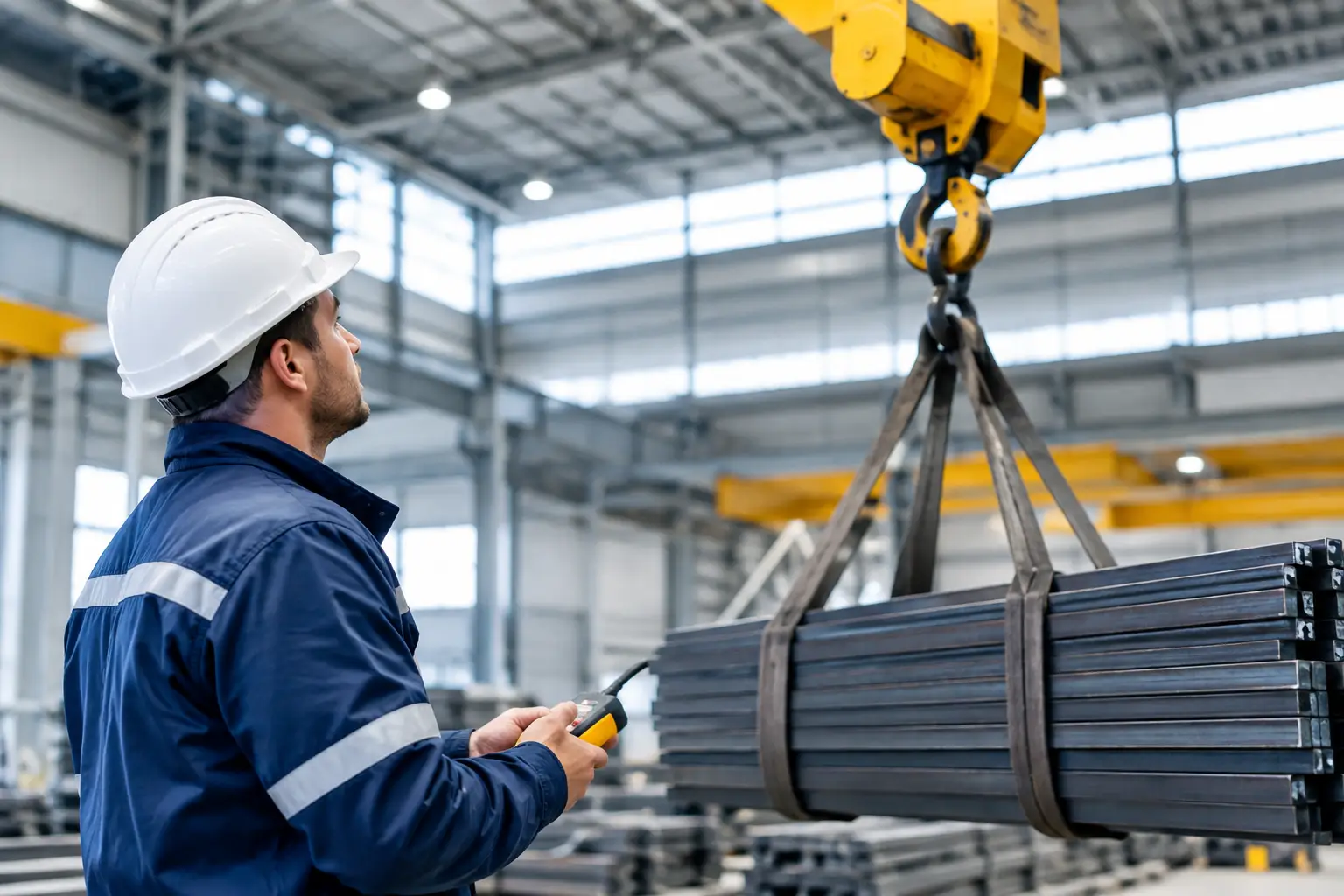
A hoist that lifts 5 tons once each week faces a very different working life from one lifting the same load every few minutes across two shifts. Hoist duty classification turns that difference into an engineering basis for selecting equipment. It helps plant teams specify a hoist that is fit for its actual operating pattern, rather than choosing only by rated capacity.
Capacity remains essential, but it is only one part of a safe and dependable lifting solution. The number of starts, lifting speed, load spectrum, running time, and expected service life all influence the stresses placed on the motor, gearbox, brake, wire rope or chain, controls, and supporting crane structure. A properly classified hoist supports predictable maintenance planning, better availability, and a more defensible capital investment.
What Hoist Duty Classification Measures
Hoist duty classification describes the severity of service an item of lifting equipment is designed to handle. It is commonly based on two related factors: how often the hoist operates and how heavily it is loaded during that operation.
A lightly used maintenance hoist may perform occasional lifts with long rest periods and rarely approach its rated load. A production hoist may make hundreds of cycles per day, often handling substantial loads at a consistent pace. Both may need the same safe working load, but they should not necessarily use the same hoist design.
The classification provides a common language for the user, project engineer, equipment supplier, and maintenance team. It establishes whether components must be designed for occasional, moderate, heavy, or very intensive service. This affects not only the hoist itself, but also the trolley, bridge crane, runway, electrification system, controls, and safety devices.
Why Capacity Alone Is Not Enough
Selecting a hoist solely by tonnage can create a hidden mismatch. A 3-ton hoist used at 60 percent of capacity for frequent repetitive lifts may require a higher duty class than a 5-ton hoist used only for infrequent maintenance work.
Repeated starting and stopping produces heat in motors and brakes. Frequent load reversals contribute to mechanical wear. High operating time accumulates fatigue cycles in gears, shafts, bearings, ropes, chains, hooks, and structural connections. These factors are not necessarily visible during commissioning, but they become evident through premature wear, unplanned downtime, and rising repair costs.
Over-specifying also has consequences. A higher-duty system can involve a larger initial investment, increased weight, more demanding power requirements, and possibly changes to the supporting structure. The right decision is therefore not simply to select the highest classification available. It is to select the classification that matches the work while allowing sensible provision for future operating growth.
The Information Needed to Classify a Hoist
A useful duty assessment starts with how the equipment will be used, not with a catalog model. Site teams should document the actual lifting task as clearly as possible.
First, establish the load spectrum. This is the proportion of lifts performed at different load levels. A hoist that regularly carries 80 to 100 percent of rated capacity experiences a different duty profile from one that usually carries light fixtures, tools, or components. Occasional peak loads also matter, especially when they are close to the hoist’s rated capacity.
Next, determine the number of operating cycles. One cycle generally includes lifting, lowering, and the related positioning movement, although the precise definition should follow the applicable standard and equipment design. Record expected lifts per hour, operating hours per shift, shifts per day, and working days per year. Production requirements should be assessed at normal output and at peak demand, not only during quiet periods.
Lift height and lifting speed must also be considered. A hoist making short, fast lifts can accumulate a high number of starts. A hoist making long vertical lifts may accumulate substantial running time even with fewer cycles. Trolley travel and bridge travel should be reviewed as well, because the full crane system must suit the duty placed upon it.
Finally, consider the operating environment. Heat, dust, humidity, corrosive atmospheres, outdoor exposure, and restricted maintenance access can all influence component selection and service intervals. Duty classification does not replace environmental design requirements. Both must be addressed together.
Understanding Common Classification Systems
Several duty classification systems are used internationally. Specifications may refer to FEM, ISO, CMAA, ASME, or manufacturer-specific designations. While these systems address similar concerns, their terminology and direct comparisons are not always identical.
For example, a classification may combine a utilization class, based on operating time or number of cycles, with a load spectrum class. The result identifies the expected service severity and theoretical design life. Other standards classify cranes and hoists through service classes that reflect the type of application, from occasional maintenance to severe production duty.
The practical point is not to force an assumed one-to-one conversion between standards. Instead, confirm which standard governs the proposed equipment, how its duty class is derived, and whether the supplier’s stated classification applies to the complete hoisting system. If a project specification includes a required class, the supporting calculations and equipment documentation should align with that requirement.
Matching Duty Class to the Application
Maintenance applications often involve low cycle counts but may still require careful consideration when lifts are critical, difficult to access, or close to rated capacity. A utility-room hoist that is used only occasionally may be classified for lighter service, while still needing dependable brakes, limit switches, and suitable controls.
Workshop and general material-handling applications usually involve more regular use. Fabrication areas, tool rooms, and warehouse operations may handle variable loads throughout the day. Here, a moderate duty classification is often appropriate, but the decision depends on actual cycles and load spectrum rather than the facility type alone.
Production lines, steel processing, continuous handling operations, and repetitive loading stations typically demand higher duty equipment. These environments may require upgraded motors, brakes designed for frequent operation, higher-capacity gear arrangements, improved thermal performance, and components selected for a greater design life. The cost is justified when it reduces interruptions in work that affects the entire operation.
High duty does not automatically mean that every component should be oversized to the same extent. The engineering team should identify the parts of the lifting system exposed to the greatest utilization and select each element accordingly. This creates a practical, fit-for-purpose design instead of unnecessary cost.
Design Choices Affected by Hoist Duty Classification
Duty classification influences far more than the nameplate. The hoist motor must tolerate the expected starts, operating duration, and heat buildup. The brake must provide reliable holding and controlled stopping throughout its intended service. Gearboxes, bearings, rope drums, chain wheels, and hooks must have suitable fatigue performance for the projected working life.
Control selection also matters. Variable-speed control may improve load positioning and reduce mechanical shock in certain applications, but it must be selected and configured for the operating duty. Limit switches, overload protection, emergency stopping arrangements, and condition-monitoring options should reflect the risks and access conditions at the site.
The supporting structure deserves equal attention. A higher-duty hoist can place greater demands on the crane girder, end carriages, runway, columns, and building support. Installing a high-capacity or high-duty hoist on an inadequately assessed structure does not create a complete lifting solution. The equipment and supporting system must be engineered as one arrangement.
Avoiding Common Specification Errors
One common error is estimating cycles from a best-case workflow rather than observing real production behavior. Operators may make extra positioning movements, perform more frequent lifts during peak shifts, or use the same crane across several work areas. A short site study often reveals a more demanding profile than the original estimate.
Another error is treating a future expansion as an afterthought. If a facility expects to add a second shift, increase throughput, or handle heavier assemblies, it may be economical to account for that change during initial design. This does not always mean selecting the next highest duty class. It means comparing the cost of suitable provision now against future equipment replacement, structural modification, and downtime.
Maintenance history is also valuable input. Repeated brake adjustments, motor overheating, rope deterioration, or gearbox issues may indicate that the present duty profile exceeds the equipment’s intended service. A maintenance review should examine the cause, not only replace the affected part.
A Practical Duty Assessment Process
For new installations, begin with a lifting survey that records load weights, dimensions, lift heights, cycle frequency, travel requirements, work shifts, environmental conditions, and layout constraints. Include the heaviest expected load as well as the load most frequently handled. Both are needed to understand the real load spectrum.
For existing facilities, review production records and speak with operators and maintenance personnel. Their experience can identify peak periods, awkward handling tasks, and areas where lifting equipment is used beyond its original purpose. This information supports a more accurate recommendation than a capacity-only replacement.
The final equipment proposal should clearly state rated capacity, applicable duty classification, governing design standard, assumptions about utilization, and any operating limitations. It should also address inspection access, spare-parts support, and planned maintenance. For industrial facilities, the value of a hoist is measured over years of safe operation, not only at installation.
A well-chosen duty class gives operations teams a reliable foundation: equipment suited to the work, maintenance planned around realistic use, and fewer surprises when production demand increases. Before approving a hoist, ask one practical question: how will this equipment actually work through its busiest shift? The answer should guide the design.