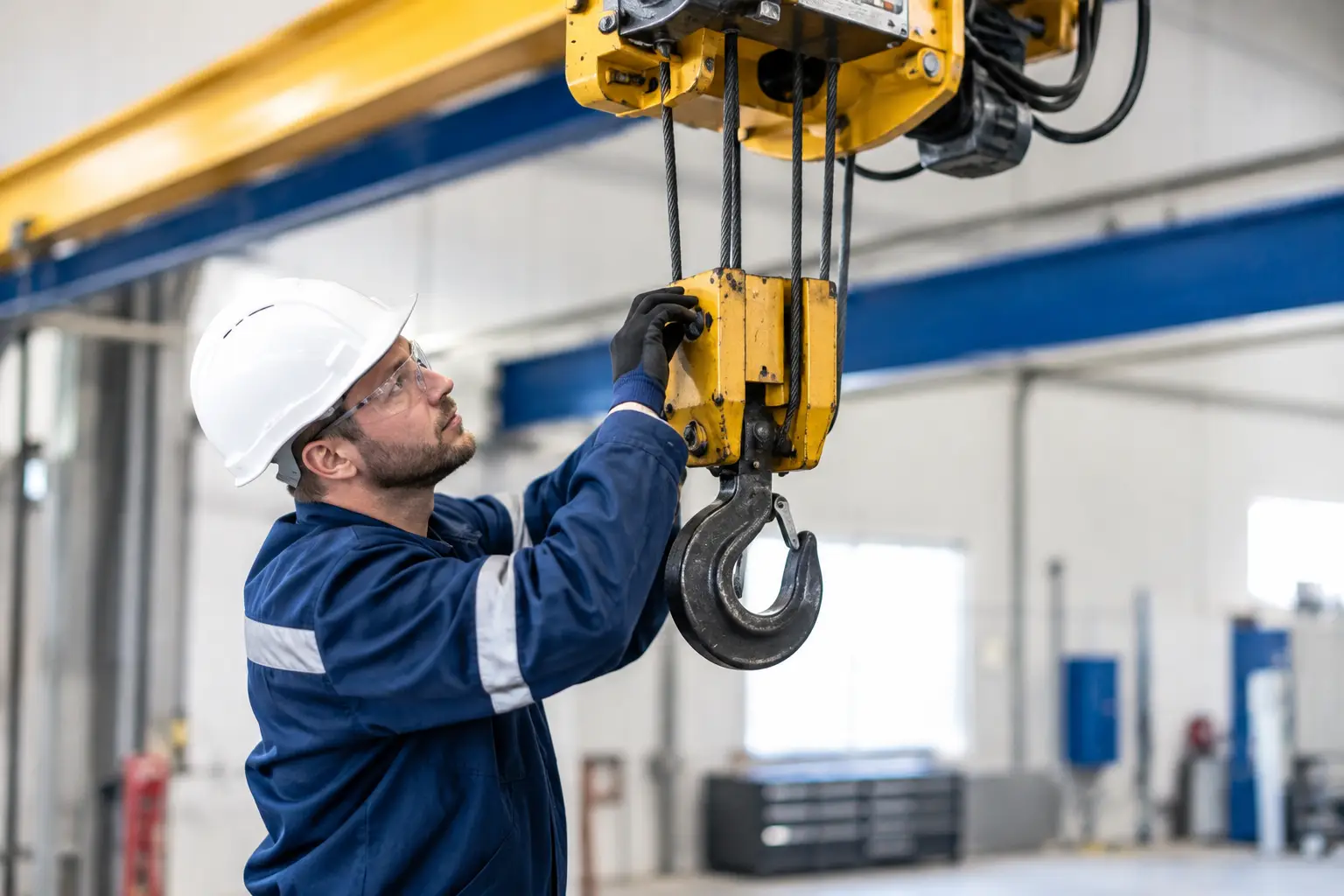
A hoist that slows under load, drifts out of position, trips repeatedly, or makes unfamiliar mechanical noise is not a minor maintenance issue. It is an operational warning. A timely hoist repair service helps restore safe lifting performance before a developing fault becomes a production stoppage, damaged load, or personnel risk.
For plant and warehouse operators, the objective is not simply to get a hoist running again. The real objective is to return it to service with confidence that its lifting, braking, control, and safety functions are working as intended. That requires a technician who can diagnose the cause of failure, assess the condition of related components, and recommend a repair scope that matches the equipment’s duty, age, and operating environment.
Why Hoist Failures Need Engineering Attention
A hoist is part of a lifting system, not an isolated machine. Its performance depends on the condition of the lifting mechanism, wire rope or load chain, brake, motor, gearbox, electrical controls, limit switches, pendant station, trolley, and supporting crane structure. A fault in one area can place added stress on another.
For example, a worn brake may allow load drift, but repeated drift can also indicate an adjustment issue, contaminated friction surfaces, or an electrical control problem that prevents proper brake engagement. Replacing one component without checking the wider system may provide a short-term fix while leaving the original cause unresolved.
This is why competent repair work begins with inspection and fault finding. The technician should understand how the equipment operates under its actual working conditions, including load frequency, travel distance, load type, environmental exposure, and operator use. A hoist used occasionally for maintenance work will wear differently from one operating multiple shifts in a production line.
Signs That a Hoist Repair Service Is Needed
Some failures are immediate and obvious, such as a hoist that will not lift or lower. Others develop gradually and are easier to miss when production schedules are tight. Maintenance teams should treat changes in operating behavior as a reason to investigate rather than wait for a complete breakdown.
Common warning signs include unusual grinding or knocking noises, jerky lifting or lowering, delayed brake response, excessive vibration, overheating, repeated overload trips, intermittent pendant controls, damaged wire rope or chain, and abnormal hook movement. Oil leakage around a gearbox, visible wear on a load chain, or a limit switch that fails to stop travel are also conditions that require prompt attention.
The right response depends on the finding. A straightforward pendant cable fault may be resolved quickly. In contrast, damage to gearing, a brake assembly, or a lifting medium can require a more detailed assessment, parts replacement, functional testing, and a review of whether the hoist has been operated beyond its intended duty.
What a Professional Hoist Repair Service Should Cover
Effective repair is a controlled technical process, not a parts swap. The work should start by making the equipment safe, isolating its power source, and inspecting the hoist before dismantling components. The repair team can then identify visible wear, mechanical damage, electrical faults, and conditions that may have contributed to the issue.
A proper scope commonly includes inspection of the hook and latch, load chain or wire rope, drum or chain wheel, bearings, gearbox, brake, motor, couplings, controls, electrical cabling, limit switches, and pendant station. On crane-mounted systems, the trolley, runway interface, power supply arrangement, and travel controls also deserve attention.
After repairs are completed, the hoist should be reassembled correctly, adjusted where necessary, and tested through its full operating functions. This includes checking lifting and lowering response, brake holding performance, limit operation, control direction, and any safety devices fitted to the system. Where the repair involves critical lifting components or follows a significant fault, testing should reflect the equipment’s operating requirements and applicable site procedures.
Clear service documentation adds value. It gives maintenance managers a record of the fault, work completed, parts replaced, observations made, and recommended follow-up actions. Over time, these records reveal repeat issues and help determine whether continued repair remains commercially sensible.
Repair or Replacement: Making a Practical Decision
Not every hoist fault calls for replacement. A quality unit with a serviceable structure, available spare parts, and a known operating history can often provide many more years of dependable use after repair. This is particularly true when the issue is confined to wear components, electrical controls, brakes, or a specific mechanical assembly.
Replacement becomes a stronger option when critical components are extensively worn, spare parts are obsolete, repair costs approach the value of a suitable new unit, or the existing hoist no longer matches the facility’s lifting needs. A change in load capacity, lift height, duty cycle, speed requirement, or working environment may justify a new solution rather than repeated corrective work.
The lowest immediate repair price is not always the lowest operating cost. A limited repair may be appropriate for lightly used equipment nearing planned replacement. For a production-critical hoist, however, a more complete repair using appropriate parts and a preventive maintenance plan may reduce far greater costs from future downtime.
Reduce Repeat Failures With Planned Maintenance
Breakdown repair is sometimes unavoidable, but it should not be the main maintenance strategy for essential lifting equipment. Planned inspections allow wear and adjustment issues to be addressed while the hoist is still operational and before they affect output or safety.
The correct maintenance interval depends on usage and conditions. Hoists in high-cycle manufacturing areas, humid locations, dusty workshops, outdoor service, or corrosive environments generally need more frequent attention than lightly used indoor equipment. Load handling practices matter too. Frequent shock loading, side pulling, lifting near rated capacity, and poor chain or rope handling can shorten component life.
A practical maintenance program combines regular operator checks with scheduled professional servicing. Operators are often the first to notice changes in sound, speed, control response, or hook behavior. Their observations should be reported and recorded, not treated as routine quirks of an aging machine.
Maintenance teams should also review the root cause after significant repairs. If wire rope damage occurs repeatedly, for instance, the answer may involve reeving, drum condition, sheave alignment, fleet angle, load handling practices, or environmental corrosion. Replacing the rope alone may not stop the problem.
Choosing the Right Service Partner
A hoist repair provider should bring more than general mechanical capability. Look for technical knowledge of lifting equipment, access to suitable spare parts, experience with electrical and mechanical fault diagnosis, and the ability to support the full system where required. Response time matters, but so do the quality of diagnosis and the availability of follow-up support.
For facilities in Malaysia, local parts availability can make a meaningful difference when a repair is urgent. A provider that can inspect, repair, supply components, and advise on longer-term maintenance gives operations teams a clearer path from immediate recovery to improved equipment reliability.
MFEI approaches lifting equipment as a lifecycle investment. That means considering the condition of the hoist, the demands of the site, the practicality of the repair, and the maintenance support needed to keep the system productive after it returns to service.
A hoist should not have to fail completely before it receives attention. Acting on early warning signs and choosing repair work that addresses the real cause protects uptime, people, and the working life of the lifting system.