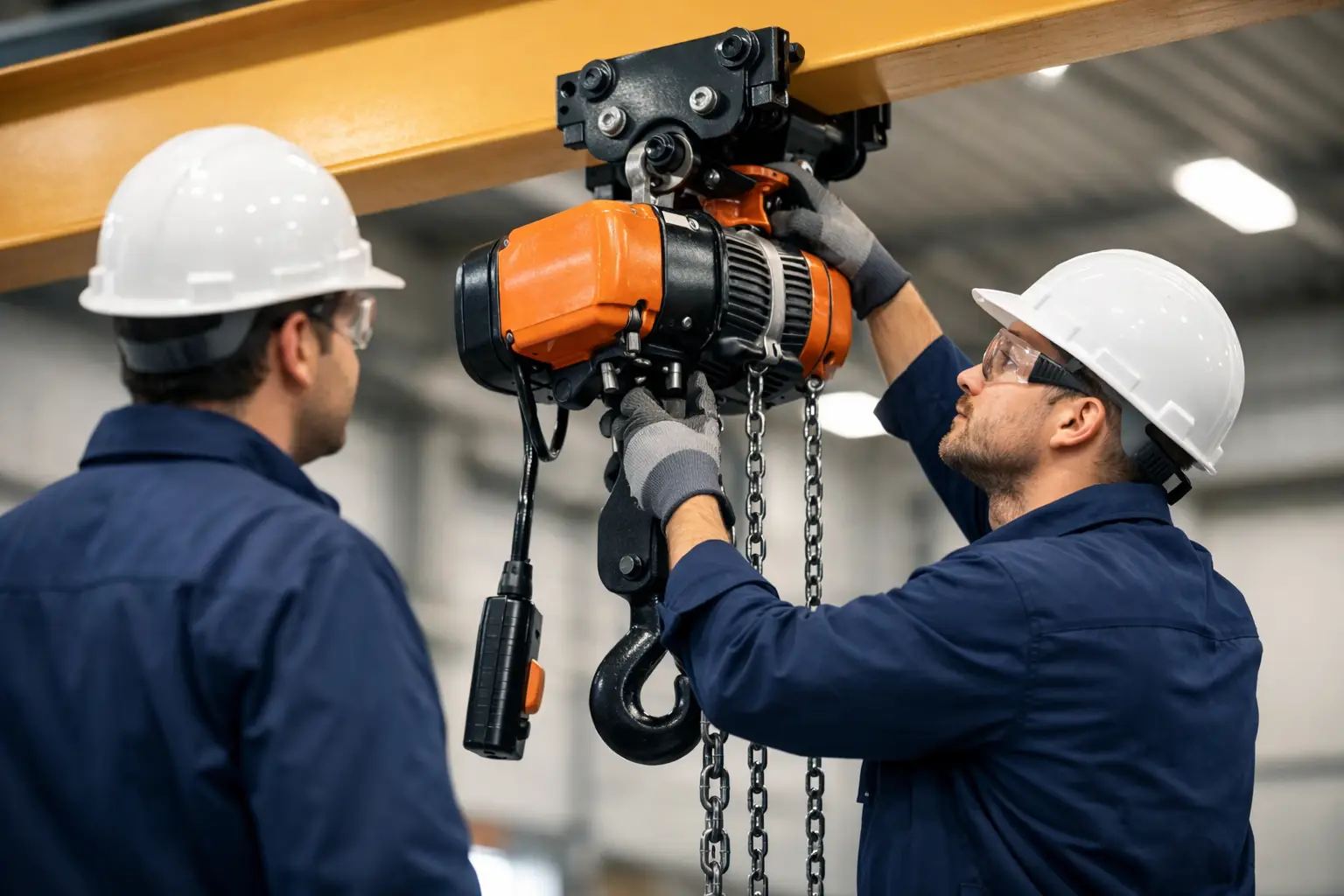
An electric chain hoist is only as safe as the structure, controls, and commissioning process around it. To install electric chain hoist safely, treat the work as an engineered lifting-system project, not simply an equipment fit-up. A hoist may have the correct rated capacity, but it can still create serious risk if the supporting beam, trolley adjustment, electrical protection, or operating clearances are wrong.
For plant, warehouse, and workshop teams, a proper installation protects people, preserves equipment life, and prevents downtime after the system enters service. The right approach begins before the hoist arrives on site and continues through load testing, documentation, and operator handover.
Start With the Actual Lifting Requirement
The rated load is the first question, but it is not the only one. Confirm the heaviest item to be lifted, including lifting attachments such as slings, spreader beams, hooks, grabs, or lifting frames. The total suspended load must remain within the capacity of the hoist and every component in the load path.
Duty cycle matters as much as capacity. A hoist used occasionally for maintenance has different requirements from one handling production materials throughout a shift. Lift height, travel distance, lifting speed, ambient temperature, dust, moisture, and available headroom can all affect the appropriate hoist configuration.
It is also necessary to understand how the load will be presented to the hook. Loads that are off-center, unstable, or routinely lifted near machinery may require a different lifting arrangement, better positioning control, or changes to the work area. Do not use a standard installation to solve a non-standard handling problem.
Verify the Supporting Structure Before Installation
The most critical safety decision is whether the existing support can carry the imposed loads. This is not limited to the hoist’s rated capacity. The structure must be assessed for the hoist self-weight, trolley weight, lifted load, dynamic effects from starting and stopping, and any runway or beam loads created during travel.
A qualified engineer should verify the monorail beam, runway beam, brackets, building columns, and connections. Check beam section size, span, flange condition, corrosion, deflection limits, end stops, and the integrity of all supporting steelwork. Welding, drilling, or modifying a beam without engineering approval can reduce its capacity and compromise the installation.
Trolley compatibility is equally important. The trolley must suit the beam flange width and profile, and its wheels must run correctly without excessive side play or binding. Incorrect trolley adjustment can damage the beam flange, cause uneven travel, and increase the likelihood of a load swing.
Where a new beam, runway, or supporting frame is required, the installation should be designed as a complete system. A sound hoist cannot compensate for undersized steelwork or poorly designed connections.
Prepare the Site and Installation Plan
Before work starts, isolate the installation area from normal operations. Establish exclusion zones beneath the work area and along the intended travel path. Coordinate with production, maintenance, and safety personnel so that overhead services, vehicle routes, personnel access, and nearby machinery are considered.
A practical pre-installation review should confirm these four items:
- Approved drawings, load data, and manufacturer installation instructions
- Structural verification and identified attachment points
- A lifting plan for raising the hoist, trolley, and associated components
- Electrical drawings, isolation arrangements, and control locations
The installation crew needs suitable access equipment, certified lifting gear, and a clear method for handling components at height. Never lift the hoist by its chain, hook, pendant cable, or electrical wiring. Use the designated lifting points and follow the equipment manufacturer’s handling guidance.
Site conditions can change the plan. Limited headroom may require a low-headroom hoist or a different lifting method during installation. A corrosive, wet, hot, or dusty environment may require specialized enclosures, components, or maintenance provisions. These are design decisions best addressed before equipment is ordered rather than after it is suspended from the beam.
Install the Hoist, Trolley, and Travel Components Correctly
Fit the trolley to the beam in accordance with the specified wheel spacing, suspension arrangement, and locking method. Confirm that the hoist is level, the chain hangs freely, and the hook can travel without striking obstructions. On motorized systems, check that travel direction corresponds with the pendant labels and that end stops are positioned to prevent collision with beam ends, cable festoons, or adjacent equipment.
The load chain requires particular attention. It must not be twisted, kinked, damaged, or routed incorrectly through the chain guide. On multi-fall chain arrangements, an unnoticed twist can affect chain movement and create dangerous hook behavior. Verify the lower hook block, safety latch, chain stop, and limit-switch operation before any load is applied.
Do not rely on the upper and lower limit switches as routine operating stops. Their purpose is to prevent over-travel and provide protection against incorrect operation. Operators should stop the hook before reaching those limits during normal work.
For systems with a festoon cable, conductor system, or cable reel, ensure the electrical supply moves freely through the full travel range. Cables must not drag, snag, chafe against steelwork, or become tensioned at either end of travel. Poor cable management is a common cause of intermittent control faults and unplanned downtime.
Make the Electrical Connection Safe and Serviceable
Electrical work should be completed by qualified personnel in line with applicable electrical requirements, equipment documentation, and site procedures. Confirm that the incoming voltage, phase, frequency, and earthing arrangement match the hoist nameplate and control design. A supply mismatch can damage motors, brakes, contactors, and electronic components before the hoist ever performs useful work.
Provide a clearly identified isolator that can be locked out for maintenance. The control pendant should be positioned so the operator can stand clear of the suspended load, observe the lifting zone, and avoid pinch points. Emergency-stop controls must be accessible and tested as part of commissioning.
Check phase rotation before full operation. Incorrect phase sequence can reverse motion directions, creating immediate risk when a user expects the hook to rise but it lowers instead. Confirm lifting, lowering, and travel directions at slow, controlled speed with the area clear.
Test Before Releasing the Hoist for Use
Commissioning is where installation assumptions are proven. Begin with visual checks: fasteners tightened to specification, retaining devices fitted, wiring secured, guards in place, labels legible, and no interference along the hook or trolley travel path.
Next, conduct no-load functional tests. Run the hook through its full lift range and the trolley through its full travel range. Test the brake, upper and lower limits, emergency stop, pendant response, and any overload protection or warning devices supplied with the system. Listen for abnormal noise, inspect for chain rubbing, and check that travel is smooth.
Load testing should follow the manufacturer’s requirements, the applicable legal and site requirements, and the approved commissioning procedure. It should be performed by competent personnel using a controlled test load. The objective is not merely to prove that the hoist can lift a weight. The test must confirm brake holding performance, structural behavior, control response, and safe operation throughout the intended travel range.
If excessive beam deflection, jerky travel, brake slip, unusual noise, or control faults appear during testing, remove the equipment from service until the cause is assessed and corrected. A rushed handover is rarely less expensive than an incident or a production stoppage.
Complete Handover With Operators and Maintenance Teams
A safe installation remains safe only when people understand its limits. Operators should be instructed on rated capacity, pre-use checks, correct slinging practices, pendant use, travel limits, emergency-stop operation, and prohibited practices such as side pulling, shock loading, lifting people, or standing beneath a suspended load.
Maintenance teams need the equipment manual, wiring diagrams, inspection records, test certificates, recommended lubrication and service intervals, and a record of installed parts. Keeping this information available shortens fault diagnosis and supports consistent preventive maintenance.
Establish a routine inspection program based on usage and operating conditions. Frequent-use production hoists need closer attention than lightly used maintenance hoists. Chain wear, hook opening, brake performance, controls, limit switches, trolley wheels, and electrical cables should all be inspected at suitable intervals by competent personnel.
Safe Installation Is a Lifecycle Commitment
An electric chain hoist should fit the facility, the load, the duty cycle, and the people who will operate it. When the supporting structure is verified, electrical and mechanical details are properly commissioned, and service planning begins at handover, the result is more than a working hoist. It is a dependable lifting solution that supports safer, more predictable operations for years to come.