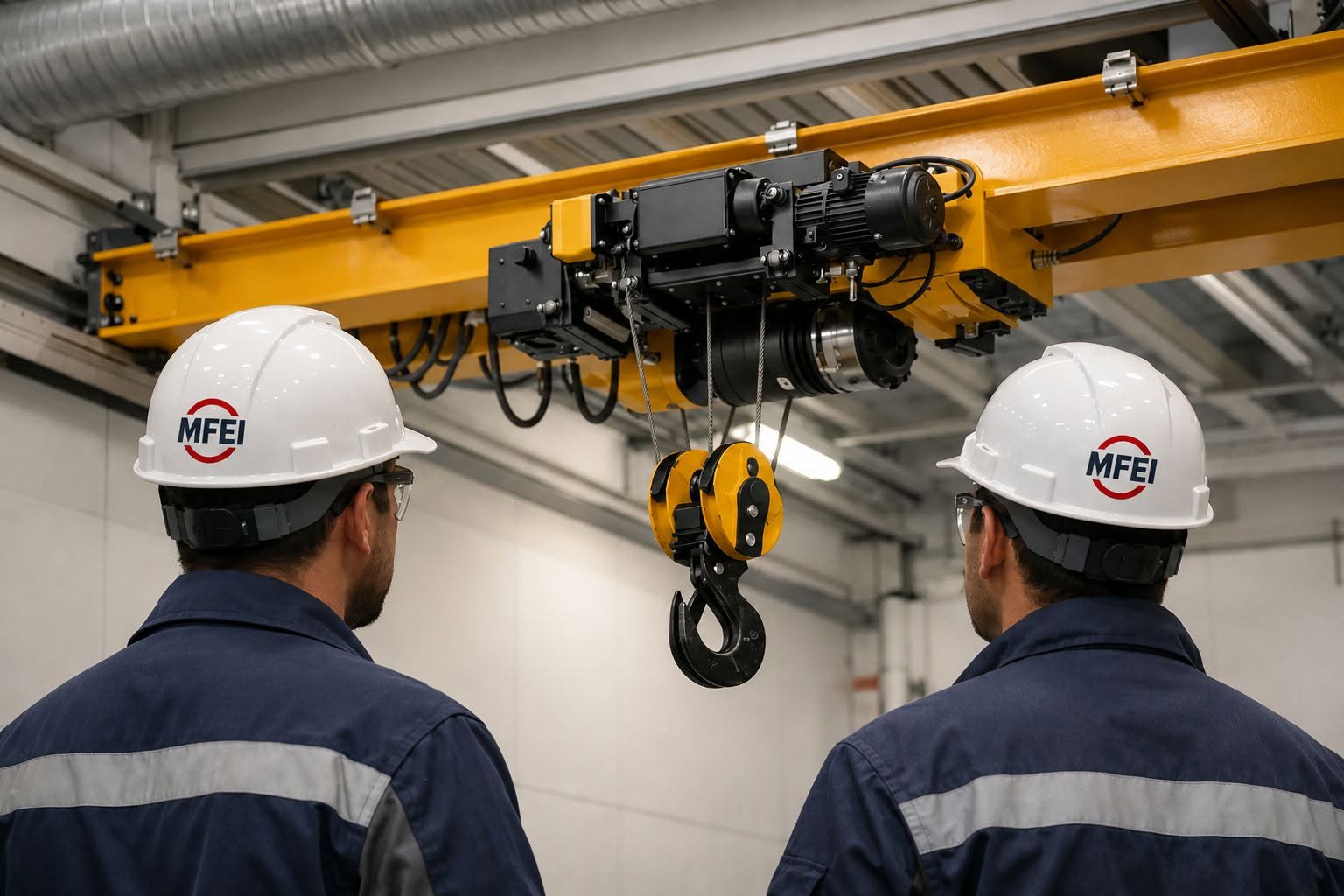
A crane can have the right rated capacity and still be the wrong solution if the hook cannot reach the required lifting height. For facilities comparing the best cranes for low headroom, the decision starts with the distance between the floor and the lowest obstruction – not with the crane’s tonnage alone. Roof trusses, lights, ducting, sprinkler lines, existing runway beams, and the load itself all reduce usable vertical space.
A low-headroom lifting solution must preserve as much hook travel as possible while remaining safe to operate, practical to service, and compatible with the building structure. The most effective configuration depends on the load path, duty cycle, available support steel, and the height at which materials must be picked up and set down.
What Low Headroom Actually Means
Headroom is the vertical space consumed by the crane system above the hook. It includes the hoist body, trolley, bridge girder arrangement, runway interface, electrical components, clearances, and the distance required between the hook and the crane structure. Every component matters when operators need to lift tooling, molds, machinery, or fabricated parts close to the ceiling.
The key figure is not simply ceiling height. It is the available lift: the vertical distance from the finished floor to the lowest permanent obstruction, less the space taken by the crane and the safe clearance required for operation. A site with a high roof may still have poor lifting height if deep roof beams or services occupy the working zone.
This is why a building drawing alone is rarely enough. A proper assessment should verify actual dimensions on site, identify obstructions across the full travel path, and establish the highest required hook position for the heaviest or tallest load. A few inches of lost lift may prevent a mold from clearing a machine or force unsafe handling practices.
Which Are the Best Cranes for Low Headroom?
There is no single crane type that is best for every restricted-height facility. The right choice is determined by whether the lifting area needs full building coverage, a fixed travel path, or localized handling at one workstation.
Double-Girder Overhead Cranes With a Top-Running Trolley
For many high-capacity applications, a top-running double-girder overhead crane provides the strongest route to maximum hook height. The trolley and hoist can be positioned between the two bridge girders rather than hanging entirely below one girder. This arrangement reduces the vertical depth between the crane bridge and the hook.
It is particularly suitable for production areas handling heavy machinery components, dies, large fabricated assemblies, or loads that need frequent lifting over a broad bay. Double-girder systems also support higher capacities and longer spans more effectively than many single-girder arrangements.
The trade-off is cost and building requirements. A double-girder top-running crane needs runway beams, supporting columns or a capable existing structure, and sufficient clearance above the bridge for travel and electrical systems. It can offer excellent lifting height, but its structural demands should be evaluated early in the project.
Top-Running Single-Girder Cranes With Low-Headroom Hoists
A top-running single-girder crane is often a practical choice where capacity and span are moderate but lifting height remains important. The bridge runs on top of runway rails, allowing the crane to sit higher relative to the building than an underslung system. A purpose-designed low-headroom wire rope hoist can further reduce the space lost beneath the girder.
This configuration may suit workshops, maintenance bays, warehouses, and manufacturing lines where the crane needs to cover a rectangular work area without the cost or complexity of a double-girder system. It also works well when existing runway beams are available and structurally suitable.
Its limitation is inherent in the layout: the hoist and trolley generally operate below the bridge girder. Where every inch of hook height is critical, a double-girder configuration may create more usable lift. The comparison should be based on actual hook elevation drawings, not general assumptions about crane type.
Underslung Single-Girder Cranes
Underslung, or under-running, cranes travel on the lower flange of runway beams suspended from the roof structure. They can be valuable when floor-mounted columns would interfere with production flow, storage racks, or vehicle movements. They are commonly considered for lighter-duty handling and facilities with an appropriate roof support arrangement.
In certain buildings, an underslung crane can be the most practical way to introduce overhead lifting without constructing independent runway columns. It may also allow the crane to follow complex layouts, including curved tracks in specialized systems.
However, an underslung system does not automatically provide the greatest hook height. The runway beams and bridge are located below the roof structure, and the hoist still takes up space beneath the bridge. Roof load capacity, deflection, and connection details require careful engineering review before this option is selected.
Monorail Systems With Low-Headroom Hoists
When materials follow a repeatable route from one station to another, a monorail may be more efficient than a full-coverage overhead crane. A low-headroom hoist travels along a fixed beam path, moving loads between machines, work cells, inspection areas, or loading points.
Because the system serves a defined route, it can often be integrated closely below roof steel or around building obstructions. Monorails are useful for repetitive handling where operators do not need to position loads across the whole bay.
The limitation is flexibility. A monorail cannot provide the side-to-side coverage of a bridge crane. It is best used where the process itself dictates the travel path and where reducing manual handling is more valuable than general-purpose lifting coverage.
Wall-Mounted or Column-Mounted Jib Cranes
A jib crane can be the right low-headroom answer for a localized lift, such as servicing a machine, loading a workbench, changing a die, or handling materials at a packing station. Wall-mounted jibs avoid consuming floor space with a dedicated column, while freestanding jibs can be positioned where building steel is unsuitable.
These systems can be fitted with low-headroom hoists and are often less disruptive to install than a full overhead runway. They are not a replacement for an overhead crane when loads must travel across a large area, but they can solve a focused handling problem at a sensible cost.
Workstation Bridge Cranes
For lighter loads and frequent manual positioning, enclosed-track workstation cranes can be effective in constrained spaces. Their low rolling resistance allows operators to move loads precisely, which can improve ergonomics and reduce reliance on forklifts in assembly or maintenance areas.
A workstation system must still be designed around the available vertical space, especially where it is suspended from roof steel. It is best suited to lighter capacities, shorter spans, and repetitive operations rather than heavy industrial lifting.
Evaluate Hook Height Before Comparing Prices
The best crane proposal should state the expected maximum hook height, not only the crane capacity and span. Ask for a section drawing that shows the floor level, load height, hook position, hoist, trolley, bridge, runway, roof steel, and lowest building obstruction. This drawing turns a vague headroom concern into a measurable engineering decision.
The load itself must be included. A tall fixture, lifting beam, spreader beam, chain sling, or specialized lifting attachment can consume substantial vertical space below the hook. Selecting a low-headroom crane while overlooking the height of the lifting gear can leave the operation with the same practical problem.
It is also wise to consider future product changes. A crane designed around today’s pallet height or tooling dimensions may become restrictive when a new machine, larger mold, or different handling fixture is introduced. Allowing reasonable capacity and height margin is often less costly than modifying a crane system after installation.
Low Headroom Does Not Remove Structural and Service Requirements
A compact crane arrangement still transfers wheel loads, impact forces, and lateral forces into the building or its independent support structure. The supporting steel, runway alignment, connections, and foundations must be designed for the selected system. Raising the crane closer to roof steel may improve hook height, but it can make installation tolerances and maintenance access more demanding.
Service access is a frequent oversight. Hoist brakes, wire ropes, limit switches, gearboxes, electrical panels, and pendant or radio-control components need inspection and maintenance throughout the equipment life. A configuration that saves vertical space but leaves no practical access route can increase downtime and maintenance cost.
Controls and protection features also deserve attention. Upper and lower limit switches, overload protection, anti-collision measures where needed, emergency stops, and clear operating procedures help protect personnel and equipment in tight working envelopes. The crane should be engineered for the way the facility actually operates, including shift patterns, lift frequency, operator visibility, and the consequences of an unplanned stoppage.
A Fit-for-Purpose Design Protects Operating Height
Low headroom projects reward careful site measurement and early coordination between operations, maintenance, building teams, and crane engineers. At MFEI, this means assessing the load, travel path, structure, available height, and service needs together rather than treating the crane as an isolated purchase.
The most valuable lifting system is not necessarily the one with the lowest profile on paper. It is the one that gives operators the required hook height, handles the real workload safely, and remains maintainable for years of productive service.
3 responses to “7 Best Cranes for Low Headroom Facilities”
[…] common retrofit challenge is available headroom. Raising the runway may improve hook lift, but it can conflict with roof trusses, lighting, fire […]
[…] Available headroom often determines the most suitable configuration. The distance from the top of the load to the roof structure, services, lighting, cable trays, and fire-protection equipment may limit the crane hook approach. A low-headroom hoist arrangement can preserve valuable lifting height, but it still needs safe clearance from all obstructions. […]
[…] low-headroom hoist or a single-girder configuration may preserve valuable vertical clearance. On the other hand, a […]