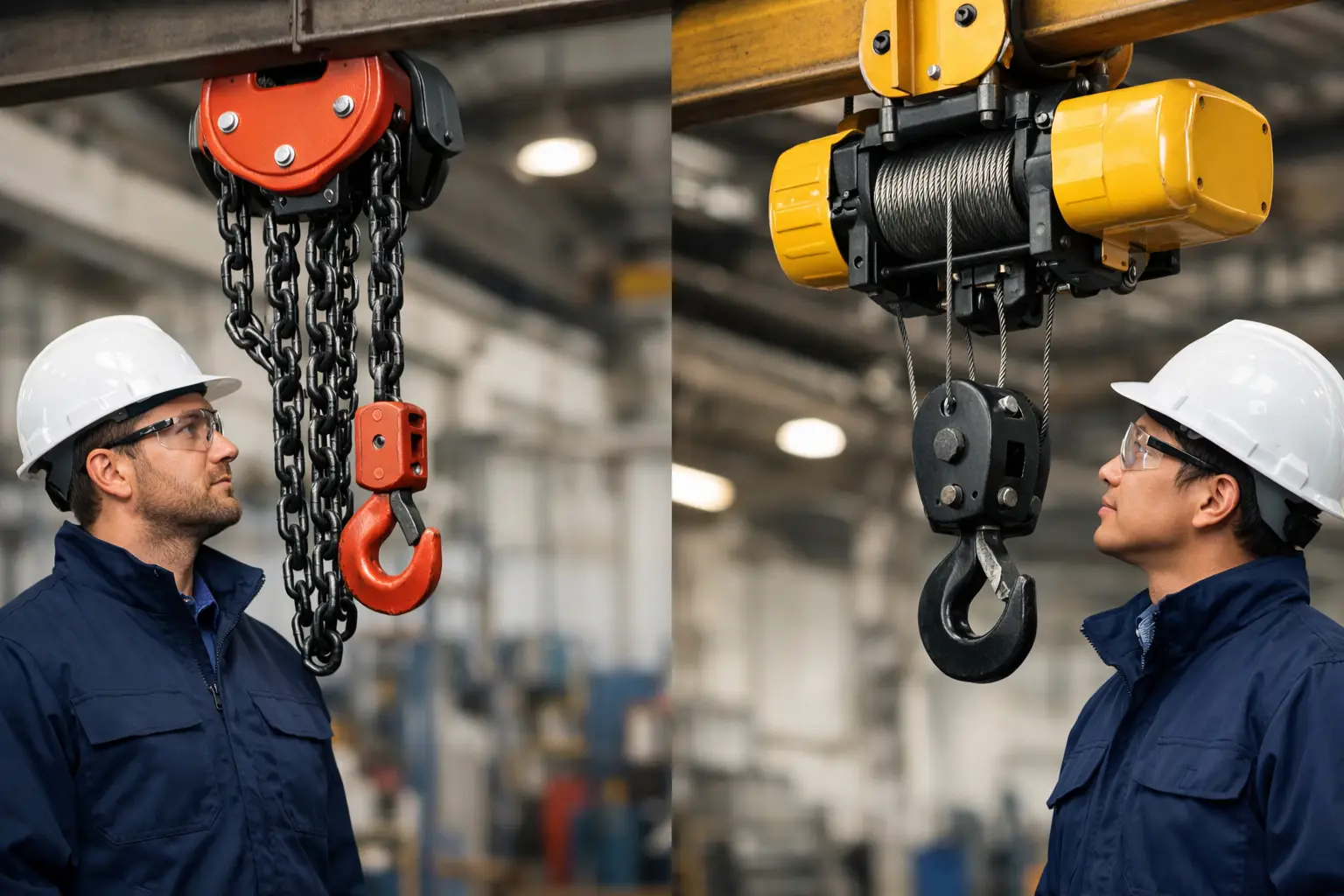
A hoist that is inexpensive to buy but poorly matched to its work can become the costliest part of a lifting system. The decision between a chain hoist versus wire hoist affects lifting speed, available headroom, maintenance planning, operator control, and the long-term uptime of an overhead crane or monorail installation.
Neither design is universally better. A chain hoist often provides a practical, compact answer for moderate loads and intermittent handling. A wire rope hoist is commonly the stronger choice where loads are heavier, lift heights are greater, or production depends on repeated, fast lifting cycles. The correct specification starts with the actual duty, not simply the rated capacity shown on a quotation.
Chain Hoist Versus Wire Hoist: The Core Difference
A chain hoist lifts with a calibrated load chain that passes over a pocket wheel, commonly called a lift wheel. In electric models, a motor and gearbox drive that wheel; manual models use hand chain operation. The load chain is compact, durable, and well suited to a wide range of workshop, warehouse, maintenance, and light manufacturing tasks.
A wire rope hoist lifts with a steel wire rope that winds onto a grooved drum. Its construction allows the rope to be stored in multiple layers or, depending on the arrangement, in a single layer for more precise performance. The drum, reeving arrangement, and trolley configuration make wire rope hoists particularly suitable for higher capacities, longer hook travel, and demanding overhead crane service.
The distinction is more than the lifting medium. Chain and wire rope hoists have different physical envelopes, maintenance needs, lifting characteristics, and installation implications. Selecting one without considering the crane runway, building clearance, duty classification, and process flow can create constraints that are expensive to correct later.
When a Chain Hoist Is the Better Fit
Chain hoists are frequently selected for capacities in the lower to medium range, especially where the required lift is modest and handling is periodic rather than continuous. Their compact body can be valuable in facilities with limited headroom. On a monorail, jib crane, workstation crane, or light overhead crane, every inch of hook approach and vertical clearance can influence whether equipment fits below an existing roof structure, ductwork, or services.
For maintenance departments, chain hoists are often a sensible option. A motor may need to be lifted a few times each month, tooling may need repositioning during changeovers, or components may need occasional transfer between workstations. In these applications, high lifting speed is usually less important than dependable operation, straightforward controls, and economical service.
Load chain also tolerates certain operating environments well. It is less affected by fleet angle issues than wire rope on a drum and can be a practical choice where a compact hoist must travel around curves on a monorail. However, this does not remove the need for inspection. Chain wear, elongation, twisting, corrosion, improper lubrication, and damage from side pulling can all affect safe operation.
A chain hoist may be less suitable when lift height is extensive. As lift increases, the hanging chain container becomes larger and the stored chain adds weight and space requirements. Long lifts may also reduce operating efficiency, particularly where frequent movement is required throughout a shift.
When a Wire Rope Hoist Is the Better Fit
Wire rope hoists are generally specified for heavier industrial lifting, higher duty cycles, and applications requiring longer lifts or faster operation. They are a common choice on single-girder and double-girder overhead cranes serving fabrication lines, production bays, steel handling areas, loading zones, and material transfer systems.
The drum-based design provides advantages when a facility needs substantial hook travel without a large chain container. A properly configured wire rope hoist can also provide high lifting speeds, controlled lowering, and a range of reeving options to suit capacity and service requirements. For a production process where a crane completes many lifts per hour, these characteristics can directly support throughput.
Wire rope hoists are not automatically the right answer for every heavy load. Their larger body and drum can demand more headroom and affect end approach dimensions. The crane girder design, trolley arrangement, runway elevation, and building structure must be assessed together. A hoist cannot be selected in isolation from the rest of the material-handling system.
Maintenance also requires a disciplined approach. Wire rope must be inspected for broken wires, kinking, crushing, corrosion, diameter reduction, and poor spooling. The drum grooves, rope guide, sheaves, bearings, brakes, and limit switches require regular attention. Where the equipment is central to production, planned preventive maintenance and access to replacement parts are essential to controlling downtime.
Capacity Alone Does Not Decide the Hoist
Two hoists may each be rated for the same safe working load but perform very differently in service. Capacity confirms the maximum intended load under specified conditions. It does not confirm whether the hoist can sustain the number of starts, operating hours, lift distance, or speed required by the application.
Duty cycle is therefore one of the most important selection factors. Consider how many lifts occur per shift, the average load as a percentage of rated capacity, the distance lifted, the duration of each operation, and whether the equipment experiences frequent starts and stops. A hoist used to make occasional full-capacity maintenance lifts has a different duty requirement from one repeatedly transferring loads across a production line.
Speed also needs context. Faster lifting may reduce cycle time, but it can be counterproductive when operators need precise placement of molds, machinery, or fragile assemblies. Variable-speed controls, inching capability, and stable load handling may provide more value than maximum speed alone. The load must be positioned safely, not merely moved quickly.
Site Constraints That Change the Decision
A site survey often reveals factors that cannot be seen in a basic equipment schedule. Available headroom, runway span, column spacing, crane travel length, power supply, ambient temperature, airborne contaminants, access for maintenance, and future expansion all influence the preferred hoist type.
For example, a compact chain hoist may help preserve hook height in a low-clearance workshop. Conversely, a wire rope hoist on a properly designed low-headroom trolley may offer a better result for a high-capacity overhead crane. The answer depends on the complete arrangement, including the beam size and structural clearance above it.
The load itself must also be reviewed. A stable palletized load is different from a long fabricated beam, a rotating assembly, or a precision machine component. Some loads require spreader beams, lifting beams, below-the-hook attachments, anti-sway features, or special controls. These requirements may change the actual load imposed on the hoist and crane, so they should be included in the engineering calculation from the start.
Environmental conditions matter as well. Outdoor exposure, humidity, dust, heat, corrosive processes, and washdown requirements can change recommendations for finishes, enclosures, lubrication, controls, and inspection intervals. A standard indoor hoist configuration should not be assumed suitable for every facility.
Maintenance, Parts, and Lifecycle Cost
Purchase price is only one part of hoist cost. The larger question is how the equipment will perform over its working life. A suitable hoist should be serviceable, supported by accessible spare parts, and matched to the maintenance resources available at the site.
Chain hoists can offer a lower initial investment and relatively simple service for many applications. Wire rope hoists may require a higher upfront investment, but their capacity, speed, and duty capability can make them the more economical option for sustained industrial use. The cost of lost production from an underspecified hoist can quickly exceed the initial saving.
A maintenance plan should include scheduled inspection of mechanical components, brakes, limit switches, electrical controls, hook condition, and the lifting medium itself. Operators should also conduct pre-use checks and report abnormal noise, jerky travel, brake slipping, damaged pendant controls, or irregular rope or chain condition immediately. Equipment should never be operated beyond its rating or used for side pulling, shock loading, or lifting personnel.
MFEI approaches hoist selection as part of a full lifting-system decision. This means considering installation access, future service needs, parts availability, and the operating demands that the crane or monorail will face after commissioning.
Specify the Work, Then Specify the Hoist
The most useful starting point is a concise lifting brief: required capacity, maximum and typical load, lift height, travel path, lifts per shift, desired speed, available headroom, power supply, environment, and any special load-handling requirements. With those details, an engineer can determine whether a chain hoist or wire rope hoist fits the job and whether the supporting crane structure is equally fit for purpose.
A chain hoist is often the practical workhorse for compact, moderate-duty lifting. A wire rope hoist is frequently the better investment for heavier, faster, longer-travel, or production-critical work. Give the selection process the same attention as the load itself, and the result will be safer handling, more predictable maintenance, and equipment that supports the facility for years rather than creating the next operational bottleneck.
One response to “Chain Hoist Versus Wire Hoist: Which Fits?”
[…] Wire rope hoists are commonly selected where higher capacities, longer lifts, smooth handling, or intensive use are required. Chain hoists can be a practical and cost-effective choice for lower capacities, workstation lifting, and compact installations. However, the best option depends on application conditions, not a simple comparison of purchase price. […]